

The giants are falling. The political forest in Yaoundé is changing The Falling Baobabs: Nature’s Coup and the Succession Shadow-Play in Yaoundé the eyes of the nation and the world. Figures once considered permanent are disappearing with startling speed, while new succession mechanisms rise in their place.
By Kemita Ashu The Independentist News contributor
Yaoundé – 8 May 2026 – For more than four decades, the political forest in Yaoundé appeared frozen in time. The towering figures of the regime stood so firmly rooted that many confused physical longevity with political permanence. Year after year, the same faces occupied the same positions, giving the impression that the architecture of power itself had become immune to history, biology, and change.
But 2026 has arrived with a brutal reminder that no political order escapes nature forever. In less than five months, some of the most enduring pillars of the Cameroonian establishment have fallen in rapid succession, creating a moment of uncertainty unlike anything witnessed since the early years of President Paul Biya’s long rule. The pace of these developments has shocked even seasoned observers of Central African politics.
This is not a conventional revolution. No crowds stormed the presidential palace. No military columns rolled through the streets of Yaoundé. No ideological movement seized the state. Instead, the old order is confronting something far more inevitable: time itself. Nature has begun clearing the political forest.
While the ruling establishment scrambles to preserve continuity and stabilize succession, a deeper question now hangs over the future of the Cameroonian state: what happens when an entire political generation disappears almost simultaneously?
For Ambazonians observing events from a distance marked by conflict, displacement, and mistrust, these developments are being interpreted not merely as isolated deaths, but as signs of structural transition inside a system long perceived as immovable.
The Biological Clearing of the Deck
Since the beginning of 2026, the regime has witnessed the disappearance of several major figures whose careers stretched across decades of centralized governance.
Marcel Niat Njifenji
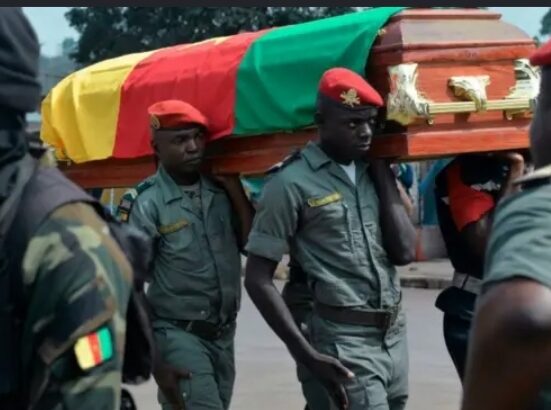
On April 11, 2026, Marcel Niat Njifenji died at the age of 91. As the pioneer President of the Senate, he represented one of the most senior constitutional figures in the country. Yet the timing surrounding his departure attracted intense political attention. Only weeks before his death, he had already been removed from the presidency of the Senate on March 17. To many observers, this appeared less like ordinary institutional transition and more like a carefully managed pre-emptive restructuring designed to stabilize succession before biology intervened.
Cavayé Yéguié Djibril
Less than a month later, on May 6, 2026, Cavayé Yéguié Djibril also passed away at the age of 86. For more than three decades, Cavayé had presided over the National Assembly and embodied institutional continuity within the ruling structure. His removal from office shortly before his death deepened speculation that the regime had anticipated a wider biological transition among the aging elite.
The symbolic impact was profound. Two of the most recognizable pillars of the post-1982 political order disappeared within weeks of one another.
Nfor Tabetando
The death of Senator Nfor Tabetando on April 22 further weakened an already aging institutional network. Beyond his role within the Senate, he represented a key traditional and regional connection inside the state’s political balancing structure.
Théodore Alexandre Mbe Essae
The passing of Théodore Alexandre Mbe Essae on the same day as Cavayé added to the atmosphere of accelerated decline surrounding the old guard. Individually, these deaths may have appeared manageable. Collectively, they created the impression of an entire political generation exiting the national stage almost simultaneously.
The Succession Architecture
What makes this period particularly significant is that the political system appeared to anticipate the biological vulnerability of its senior leadership. The constitutional reform adopted on April 4, 2026 fundamentally altered the mechanics of presidential succession.
Under the previous constitutional framework, the President of the Senate would temporarily assume leadership in the event of presidential vacancy while new elections were organized. That arrangement created at least a limited buffer between the presidency and direct hereditary continuity. The new reform changes that equation entirely.
By creating the position of an appointed Vice President with automatic succession powers, the system effectively transfers continuity away from legislative institutions and toward direct executive control. The implications are enormous.
Rather than relying on temporary constitutional caretakers, the state now possesses a mechanism for immediate executive continuity centered around a presidentially selected successor.
This reform has intensified speculation surrounding Franck Emmanuel Biya and the possibility of a managed dynastic transition within the ruling structure. While official confirmation remains limited, many analysts increasingly view recent constitutional changes through the lens of succession preparation.
To critics, the reforms represent an effort to preserve regime continuity under a younger face while maintaining the same centralized architecture of power. To supporters, they represent an attempt to avoid institutional instability during a highly sensitive political transition. Either way, the direction of travel is becoming increasingly visible.
The Last Baobab
With the deaths of Niat and Cavayé, the original post-1982 establishment has narrowed dramatically around one remaining central figure: President Paul Biya himself. At 93 years old, Biya now stands as the last towering symbol of an era that shaped modern Cameroon for more than four decades. This reality has transformed the national political atmosphere. Increasingly, the dominant question inside elite circles is no longer ideological or programmatic. It is biological. Who comes next? And perhaps more importantly: can the existing system survive the transition without major instability?
The Ambazonian Reading of Events
Within Ambazonian circles, the developments in Yaoundé are being interpreted through a very different lens. For many supporters of Ambazonian self-determination, the current transition does not represent democratic renewal, but rather an internal restructuring of the same centralized political order that presided over years of conflict in the former British Southern Cameroons.
From that perspective, changes in personalities alone are insufficient. Whether leadership passes from an aging revolutionary generation to a younger administrative elite, the deeper constitutional and political questions surrounding governance, identity, decentralization, and self-determination remain unresolved.
This explains why many Ambazonian observers remain cautious toward potential future “peace initiatives” emerging from Yaoundé during the transition period. To them, reconciliation language may serve not only as conflict management, but also as a tool for legitimizing a new succession order domestically and internationally.
At the same time, many ordinary Cameroonians — including those outside the conflict zones — are increasingly concerned about institutional fragility, economic pressures, elite succession struggles, and the possibility of uncertainty during the post-Biya era. The result is a political atmosphere filled with both expectation and anxiety.
A State Between Continuity and Transition
The deeper significance of 2026 may ultimately lie not in any single death, constitutional amendment, or political maneuver, but in the convergence of all three at the same historical moment. A biological transition is colliding with a constitutional transition. An aging political order is attempting to engineer continuity while simultaneously confronting the unavoidable pressures of generational change.
History offers many examples of states that successfully navigated such moments. It also offers examples of systems that appeared stable until succession exposed deeper structural weaknesses hidden beneath decades of centralized control. Cameroon now stands somewhere between those two possibilities.
Conclusion
The giants are falling. The political forest in Yaoundé is changing The Falling Baobabs: Nature’s Coup and the Succession Shadow-Play in Yaoundé the eyes of the nation and the world. Figures once considered permanent are disappearing with startling speed, while new succession mechanisms rise in their place. Yet beneath the personalities and transitions, the deeper political questions facing Cameroon remain unresolved. Can continuity deliver stability? Can constitutional engineering manage biological reality? Can a state built around one generation successfully reinvent itself for another? And can long-standing national conflicts truly be resolved through leadership transition alone? These questions now define the uncertain horizon ahead. Nature may be dismantling an era in Yaoundé, but history will determine what replaces it.
Kemita Ashu The Independentist News contributor