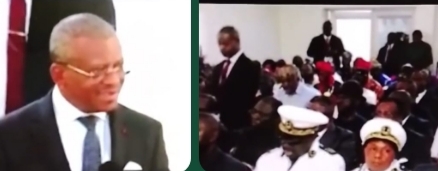
The cathedral exploded in boos — not the timid murmurs of discontent, but the full-throated rejection of a people betrayed beyond measure. The reaction was so swift, so loud, and so unanimous that even the marble pillars seemed to recoil. The Nuncio stood there, stunned. The clergy froze. The ritual collapsed.
An Independentist Editorial by M. C. Folo
The Day a People Finally Called the Bluff
What happened in the Metropolitan Cathedral of Bamenda was not a liturgical interruption. It was an uprising in sacred clothing. For decades, the people of Bamenda have swallowed their pain in silence — burying children, fleeing villages, watching their communities razed, and listening to political lies dressed up as national unity.
But on this day, surrounded by bishops, priests, and the Apostolic Nuncio himself, the dam finally broke. And the truth roared, the Moment the Nuncio Spoke the Unholy Name. The ceremony was supposed to be the Archdiocese’s moment of pride. Rededication. Renewal. Restoration, then the Nuncio uttered the name: Paul Biya. He might as well have dropped gasoline in a burning house.
The cathedral exploded in boos — not the timid murmurs of discontent, but the full-throated rejection of a people betrayed beyond measure. The reaction was so swift, so loud, and so unanimous that even the marble pillars seemed to recoil. The Nuncio stood there, stunned. The clergy froze. The ritual collapsed. For the first time in decades, the people of Bamenda spoke their truth without fear or permission. The Vatican Misread the Room — Because It Never Entered It
Let us be honest: The Apostolic Nuncio came with a script written in Yaoundé, not in the broken homes, mass graves, refugee camps, and burned villages of the North West and South West. He did not come smelling of the sheep. He came wearing the cologne of diplomatic detachment. He tried to sprinkle holy water on political brutality. Bamenda threw it right back. This was not a misunderstanding. It was a rejection of Rome’s failure to read the reality of a suffering people. No, This Was Not Disrespect — It Was a Courtroom Verdict
The boos were not against the Church. They were against the regime that has terrorized these very worshippers for years: the regime that burned their homes, the regime that killed their children, the regime that jailed their young, the regime that raped their women, the regime that destroyed their dreams, the regime that pretends their suffering does not exist.
When a representative of that regime was honored in God’s house, the people reacted as any wounded, dignified community would. They refused to let the sanctuary be used for political laundering. Archbishop Nkea Stood in the Middle — And the Middle Is No Longer Safe. The Archbishop of Bamenda is a respected figure. But this incident exposed a painful truth: The people now demand clarity, not pastoral gymnastics.
A Church that claims to stand with the oppressed cannot act as a bridge for the oppressor. The sanctuary must choose its side — and neutrality is no longer an option when bodies are still warm in shallow graves. The faithful have spoken: “No one will use our pain as liturgical decoration.”
Bamenda Delivered a Message Stronger Than Any Ballot Box. Yaoundé can rig elections. It can buy elites. It can intimidate institutions. It can fabricate mandates. But it cannot choreograph the roar of a wounded crowd inside God’s house.
The reaction inside that cathedral was the most honest political statement Southern Cameroons has produced in years. A referendum conducted without ballot papers. A judgment rendered without a courtroom. A proclamation issued without a microphone.
The people rejected the regime’s legitimacy before heaven and earth. This Was Not a Disturbance. It Was a Revolution. The incident was bigger than a ceremony gone wrong. It was the day the people of Bamenda: broke the fear barrier, broke the silence, broke the manipulation, broke the illusion of national unity, broke the myth that the Church can be used to sanitize tyranny
They reminded the world that: You cannot terrorize a people from Monday to Saturday and expect them to bow their heads meekly on Sunday. Not anymore. Not in Bamenda. Not in the burning heart of Ambazonia’s resistance. History Has Recorded the Verdict
On that day, reverence stepped aside and truth walked into the sanctuary. The faithful of Bamenda did not whisper their discontent. They shouted it in the presence of heaven, clergy, and Rome’s ambassador. The cathedral, once a symbol of silent endurance, became the loudest moral courtroom in Cameroon. The verdict was clear: The people reject the regime. Completely. Publicly, and Ireversibly.
The rededication ceremony intended to mark a new beginning. In the end, it did — just not in the way the Church or Yaoundé expected. It began a new chapter in the resistance.
M. C. Folo