

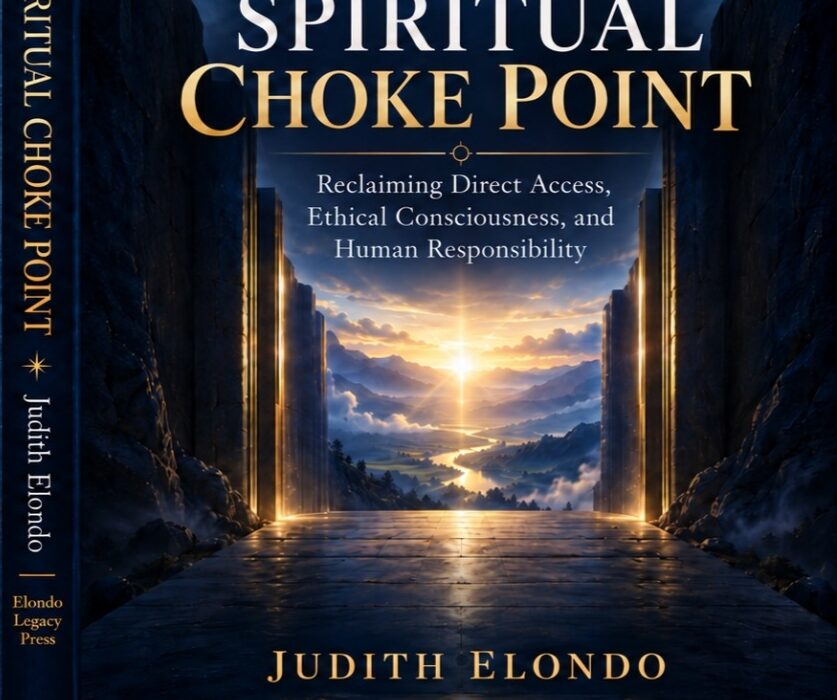


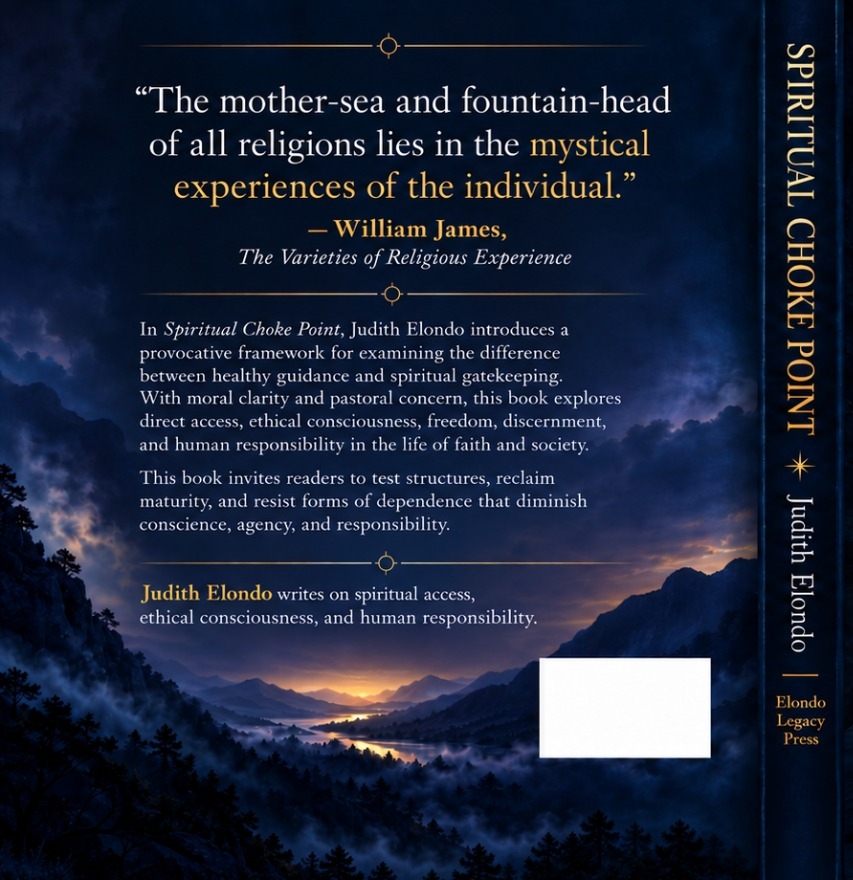
By Judith Elondo Publisher: Elondo Legacy Press
BOOK REVIEW, By The Independentist News editorial desk. Edition reviewed: 2026 revised manuscript Genre: Spiritual philosophy, ethical leadership, religious reflection, and social transformation
As Amazon associate this site earns from qualifying purchases
Buy your copies of books on Ambazonia’s productive Sovereignty and statecraft By Martin Mungwa from Amazon
Central assessment: Spiritual Choke Point offers an original conceptual framework for examining how institutions intended to guide, protect, and empower people can gradually become mechanisms of dependency and control. Its greatest contribution is the connection it draws between spiritual freedom, ethical responsibility, and institutional accountability.
The book’s central insight is that not every checkpoint is a choke point. Some forms of authority genuinely protect people; others gradually make themselves indispensable. Elondo challenges readers to recognize the difference and to restore healthy relationships between belief, conscience, authority, and action.
A Book That Moves Spirituality from Belief to Responsibility
Judith Elondo’s Spiritual Choke Point is more than a book about religion. It is an inquiry into the relationship between spiritual authority, human conscience, institutional power, and the responsibility to act ethically.
Elondo begins with a deceptively simple concern: what happens when a structure established to help people approach God gradually becomes a barrier between them and the spiritual understanding they seek? Her answer forms the basis of what she calls the Spiritual Choke Point framework.
A healthy spiritual guide strengthens understanding, encourages mature discernment, and equips individuals to exercise responsible judgment. A dysfunctional gatekeeper, by contrast, may manufacture dependency, exploit fear, restrict information, or persuade followers that meaningful spiritual decisions require its continuing permission.
One of the book’s most important qualities is its refusal to equate spiritual independence with the rejection of religious communities. Elondo recognizes the legitimate roles of churches, pastors, Scripture, scholarship, and responsible spiritual leadership.
Her criticism is directed instead at the misuse of authority, particularly when guidance becomes domination and protection becomes control. This distinction gives the work both intellectual balance and practical relevance.
Four Ethical Gateways
At the heart of the book are four guiding principles:
- Truth: Are claims supported by evidence, honesty, and reliable information?
- Conscience: Does authority strengthen moral judgment or suppress it?
- Righteousness: Is conduct ethically defensible, even when institutions permit it?
- Justice: Who benefits from a decision, who suffers, and are vulnerable people protected?
These principles form the practical foundation of Elondo’s analysis.
Their importance becomes particularly evident when she extends the discussion beyond religious institutions. A person who attends worship regularly but falsifies public records has not demonstrated ethical integrity merely through religious participation. A professional who knowingly certifies defective work cannot substitute prayer for professional responsibility. A public official who manipulates information cannot claim moral credibility simply through religious language.

Elondo’s argument is that spirituality must influence what people actually do. Faith without ethical conduct becomes an incomplete expression of spiritual responsibility. This is arguably the book’s most significant contribution.
From the Sanctuary to the Workplace and Society
The book becomes especially compelling in its third chapter, When Checkpoints Become Choke Points: Religion, Work, and Public Institutions. Through illustrative cases, Elondo examines how the same mechanisms of dependency and moral compromise can operate in different environments.
Emmanuel, a public works employee, faces pressure to approve work that he cannot verify. Claudine, an election official, is pressured to falsify election results. Samuel, an engineer, confronts the professional and ethical implications of approving substandard road construction. These are fictional teaching cases rather than documented accusations against identifiable individuals.
Their effectiveness lies in showing how ordinary people experience moral pressure. The central question is not whether they possess religious beliefs. It is whether they can translate those beliefs into truthful decisions when their livelihoods, reputations, or relationships are threatened. Elondo thereby moves spiritual reflection into the practical territory of professional ethics, public accountability, and institutional integrity.
The book suggests that ethical failure often occurs not because people lack knowledge of what is right, but because fear, dependency, incentives, and authority interfere with their willingness to act. This insight makes the work relevant to administrators, teachers, engineers, nurses, public officials, religious leaders, and professionals in positions of responsibility.
The Importance of Africa in Elondo’s Argument
One of the book’s most interesting dimensions is its engagement with African religious life and institutional development.
Religion remains an important influence in many African communities, although practices and beliefs vary considerably across the continent. Elondo avoids reducing Africa to a single religious tradition or attributing its governance difficulties to spirituality alone. Instead, she asks how religious beliefs, social expectations, inherited authority structures, economic pressures, and political institutions interact with individual conscience. This is an important intellectual direction.
Africa’s development challenges cannot be explained exclusively through economics, politics, or religion. Nor can spirituality alone solve deficiencies in public institutions. Elondo’s contribution is to propose ethical consciousness as an essential complement to institutional reform.
A government may adopt constitutional reforms while retaining corrupt administrative practices. A religious institution may attract large congregations while discouraging legitimate questions. An organization may publish ethical codes while rewarding people who disregard them. In each situation, the external structure may remain intact while its moral purpose deteriorates.
Elondo’s framework encourages readers to look beyond institutional appearances and examine the actual flow of truth, responsibility, dignity, and justice.
The Book’s Most Practical Contribution: Diagnosis and Restoration
Many books criticizing institutional power devote considerable attention to identifying abuses but provide limited guidance for correcting them. Spiritual Choke Point takes a more constructive approach.
Chapter Four, Restoring Healthy Flow, offers a method for identifying the source of a problem, examining the role of intermediaries, evaluating dependency, determining who benefits, and identifying an appropriate remedy. The book also includes a twelve-question diagnostic tool that readers can apply to personal, religious, professional, or institutional situations.
Importantly, Elondo does not recommend abolishing every checkpoint. Certain checkpoints exist to protect human life, uphold professional standards, prevent fraud, and preserve accountability. A medical safeguard should not be discarded merely because it restricts an individual’s freedom to act without proper qualifications. Engineering inspection requirements are not necessarily oppressive barriers. Safeguarding procedures may be essential to protecting vulnerable people.
The challenge is to distinguish legitimate protection from unnecessary domination. This gives the framework a practical sophistication that strengthens the book considerably. True restoration is not the elimination of accountability. It is the elimination of needless control while preserving necessary safeguards.
Spiritual Responsibility in the Age of Artificial Intelligence. Elondo extends her framework into technological ethics in the final chapter, Ethical Consciousness and the Future: Leadership, Technology, Africa, and Legacy. This is a particularly timely development.
Artificial intelligence, digital platforms, automated decision systems, and expanding institutional databases increasingly influence how people access information, opportunities, and services. These systems may improve efficiency, expand access, and support better decisions. They may also create new forms of dependency, opaque authority, and exclusion. Elondo asks readers to consider the moral architecture of the systems societies are building.
Who controls access? Who determines which information is visible? Who can challenge a decision? Who benefits from the rules? What happens to those who have the least power? These questions extend the book beyond conventional spiritual literature. They connect it to contemporary concerns about responsible technology, public administration, and human dignity.
The argument is especially valuable because it recognizes that technological sophistication does not automatically produce ethical progress. A society can develop advanced systems while remaining vulnerable to manipulation, injustice, and institutional irresponsibility.
Intellectual Strengths and Originality
One of Elondo’s strongest achievements is the development of a memorable and adaptable central concept. The phrase Spiritual Choke Point provides a useful metaphor for understanding how the flow of knowledge, conscience, authority, and responsibility can become obstructed.
The book’s originality lies less in discovering that spiritual authority can be abused—a subject examined extensively by religious scholars and social critics—and more in organizing that concern into a diagnostic framework that can be applied across spiritual, professional, institutional, and technological settings.
The author’s use of interludes, case studies, Open Windows, and Open Horizons also helps translate abstract arguments into situations readers can recognize. Another important strength is the attempt to distinguish spiritual interpretation from empirically established fact.
Elondo acknowledges that personal intuition is not necessarily divine guidance and that spiritual conviction must be accompanied by humility, discernment, and responsible judgment. This makes the argument more intellectually credible and reduces the danger of replacing institutional dogmatism with unchecked personal certainty.
The manuscript also draws on a range of scholarly perspectives, including religious experience, critical consciousness, spiritual abuse, African ethics, and human agency. These references broaden its intellectual context without displacing the author’s central framework.
Areas That Could Be Strengthened
A serious review should also identify limitations. First, the Spiritual Choke Point framework is primarily a conceptual and ethical model. Its diagnostic value is promising, but its effectiveness has not been established through systematic empirical testing.
Future work could strengthen the model through documented institutional case studies, practitioner assessments, or carefully designed research. Second, while the book’s broad application is appealing, the movement between theology, public administration, professional ethics, and technology sometimes places considerable demands on the central metaphor.
A more explicit distinction between spiritual dependency and institutional misconduct would help readers understand when the framework is being used theologically and when it functions as a wider ethical analogy.
Third, some readers may disagree with aspects of Elondo’s theological understanding of direct spiritual access. The book would benefit from continued engagement with alternative Christian interpretations and religious traditions. These limitations do not invalidate the argument. Rather, they identify opportunities for scholarly development and future editions.
Overall Judgment
Spiritual Choke Point is a thoughtful and socially relevant contribution to contemporary discussions of spirituality, conscience, ethical leadership, and institutional accountability. Its greatest achievement is its insistence that spiritual maturity must produce responsible action.
The book challenges religious believers to examine whether their convictions guide their conduct. It challenges leaders to assess whether their authority empowers or restricts those they serve. And it challenges institutions to evaluate whether their rules continue to protect their original purpose.
For African societies, the book raises especially important questions about the relationship between religious participation, public ethics, and institutional performance. For readers elsewhere, its lessons are equally applicable wherever power, dependency, and conscience intersect.
Elondo’s central message can be expressed in one proposition: A spiritual or institutional system should be judged not merely by the authority it possesses, but by the truth, dignity, discernment, and responsibility it enables. This is the book’s enduring contribution.
Spiritual Choke Point deserves consideration by readers interested in spiritual formation, religious ethics, leadership development, professional integrity, and the responsible exercise of power. It does not offer easy answers to every religious or institutional dilemma. Instead, it provides a framework for asking better questions and acting more responsibly. That is a meaningful achievement.
Final verdict: A conceptually distinctive, practically oriented, and intellectually ambitious work whose influence could extend well beyond religious readership.
Editorial evaluation
Provisional manuscript score
9.1/10
Originality of framework 9.4
Intellectual depth 9.0
Practical application 9.5
Relevance to Africa and society 9.3
Scholarly and empirical grounding 8.5
Organization and readability 9.0
This is an editorial assessment of the revised manuscript, not a peer-reviewed academic rating.
As Amazon associate this site earns from qualifying purchases
Buy your copies of books on Ambazonia’s productive Sovereignty and statecraft By Martin Mungwa from Amazon
The Independentist News editorial desk.