








News commentary

We are home to news on Cameroon and the CEMAC region. We are dedicated to honest and reliable reporting. We are the voice of the Cameroonian people and their fight for freedom and democracy at a time when the Yaoundé government is silencing dissent and suppressing democratic voices.

Those accused have denied wrongdoing, and their cases remain part of ongoing legal proceedings. These developments demonstrate that diaspora activities connected to the conflict are now being examined under international criminal law and domestic statutes governing material support and transnational violence.
By Ali Dan Ismael, Editor-in-Chief, The Independentistnews
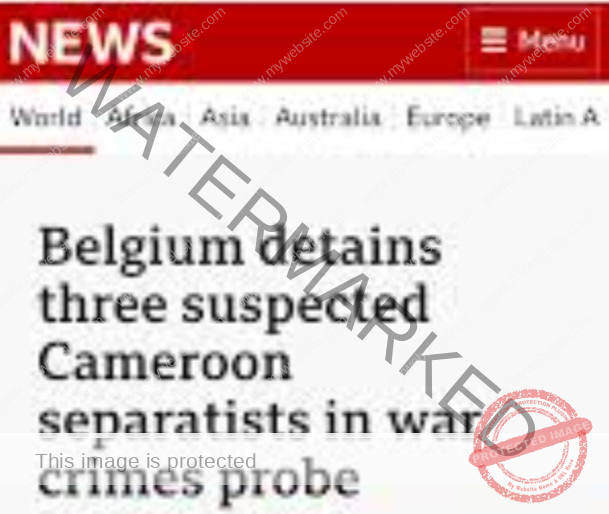
Recent developments in Belgium have once again drawn international attention to the global dimensions of the conflict in Cameroon’s Anglophone regions. Belgian authorities confirmed that four individuals were arrested during coordinated searches in Antwerp and Londerzeel as part of an investigation into alleged war crimes linked to the conflict.
Those identified in reports include Ketcha Fru, Kaavi Melchizedek, his wife, and Mua Tegha Obadiah. Belgian prosecutors stated that three of the suspects were remanded in custody while investigations continue into allegations that funds or operational coordination related to attacks in Cameroon may have been conducted from Belgian territory.
These developments highlight a growing reality: the Anglophone conflict, once treated largely as an internal crisis within Cameroon, is increasingly intersecting with international legal jurisdictions.
The Principle of Presumption of Innocence
Before drawing sweeping conclusions, it is essential to emphasize a foundational principle of democratic justice: presumption of innocence. Arrests and investigations are not convictions. Allegations must ultimately be examined and tested through judicial processes in court.
Belgian authorities have opened an investigation based on suspicions related to alleged international crimes. Whether those allegations can be substantiated remains a matter for the courts to determine. Until such proceedings are concluded, the individuals concerned remain suspects under investigation rather than convicted perpetrators. Respect for due process remains central to credible justice.
Distinguishing Political Institutions from Armed Factions
It is equally important to distinguish between the political institutions representing Ambazonian aspirations and the armed factions that emerged within the conflict environment.
The Government of the Federal Republic of Ambazonia, currently operating in exile, has consistently presented itself as a political and diplomatic authority advocating for international mediation, dialogue, and recognition of the right to self-determination. Its activities have largely taken place within diplomatic, humanitarian, and political advocacy frameworks.
By contrast, the individuals referenced in recent investigations are reported to be associated with elements linked to the Ambazonia Defence Forces (ADF), an armed faction that operates within the broader landscape of the conflict.
Structures associated with the ADF have at various times operated through diaspora networks and have been registered within civil organizational frameworks in Belgium and the United States, reflecting the presence of diaspora-based advocacy and fundraising structures in those jurisdictions. Such registration, however, does not determine the legal outcomes of ongoing investigations.
Like many protracted liberation struggles, the Ambazonian movement has evolved into a decentralized ecosystem of actors—including political organizations, diaspora groups, civil society networks, and armed factions—whose structures and chains of authority are not always unified. Recognizing this complexity is essential to avoiding simplistic interpretations of the conflict.
The Ayaba Cho Lucas Case
The Belgian arrests occur against the backdrop of another high-profile legal case in Europe. Ayaba Cho Lucas, widely associated with the Ambazonia Defence Forces, has now entered his second year in pretrial detention in Norway.
Norwegian prosecutors are pursuing charges under the principle of universal jurisdiction, alleging involvement in serious violations connected to the Anglophone conflict. His arrest marked one of the most significant attempts by a European judicial system to apply international criminal law frameworks to activities linked to the conflict.
Supporters view him as a political figure within a self-determination movement, while critics allege that armed factions linked to the ADF have carried out abuses. The Norwegian judicial system will ultimately determine the merits of the charges.
Legal Scrutiny in the United States
European proceedings are not the only legal developments involving individuals connected to the conflict.
In the United States, federal authorities have also pursued cases involving individuals accused of supporting armed activities in Cameroon. Several arrests have taken place in Minnesota and other parts of the United States, where prosecutors allege that certain diaspora actors organized funding and coordination for armed operations linked to the Ambazonia Defence Forces.
Those accused have denied wrongdoing, and their cases remain part of ongoing legal proceedings. These developments demonstrate that diaspora activities connected to the conflict are now being examined under international criminal law and domestic statutes governing material support and transnational violence.
The Internationalization of the Conflict
Taken together, the proceedings in Belgium, Norway, and the United States illustrate how aspects of the Anglophone crisis are increasingly moving into international legal arenas.
Diaspora communities across Europe and North America have played visible roles in mobilizing political advocacy, humanitarian support, and financial contributions related to the conflict. Governments are now examining whether certain activities crossed legal thresholds under domestic and international law.
This trend reflects a broader pattern in modern conflicts: diaspora networks often become deeply intertwined with struggles occurring in their countries of origin.
Justice Must Apply to All Parties
If international accountability mechanisms are to contribute meaningfully to peace, they must apply even-handedly. Numerous international human rights organizations have documented allegations of abuses affecting civilians in the Anglophone regions. These allegations have been directed not only at separatist armed groups but also at security forces operating under the Cameroonian state.
For justice to retain credibility, investigations must address violations wherever they occur and whoever commits them. Selective justice risks deepening grievances rather than resolving them.
A Legal Process, Not a Political Verdict
The arrests in Belgium, the ongoing proceedings in Norway, and the cases brought in the United States represent legal processes concerning specific individuals and specific allegations.
They should not be interpreted as judgments on the broader political aspirations of the Anglophone population, nor as determinations regarding the legitimacy of political institutions advocating for Ambazonian self-determination.
Courts will determine the legal responsibilities of those accused. But the deeper political questions surrounding the future of the Anglophone regions cannot be resolved through judicial proceedings alone.
A Conflict Larger Than the Courtroom
The proceedings now unfolding in Belgium, Norway, and the United States will determine the legal responsibilities of specific individuals. Courts are designed to establish facts, assign liability, and uphold the rule of law. But no courtroom—however rigorous—can settle the deeper political question at the heart of the Anglophone crisis. That question remains fundamentally political: how a people who trace their history to the former British Southern Cameroons can secure dignity, security, and a political future consistent with international law and their own aspirations. Until that question is addressed through credible dialogue and international engagement, legal battles abroad will continue to surface as distant echoes of a conflict whose true resolution lies not in foreign courtrooms, but in a just and durable political settlement.
Ali Dan Ismael Editor-in-Chief
Share This Post:
The Curse of Empire: From Iran to Israel to Ambazonia — The Unfinished Legacy of Imperial Strategy
Related Post
The Curse of Empire: From Iran to Israel to
Between Vigilance and Opportunity: Reading the Pope’s Visit to
Editorial Response to the fervent reader from Bui County:
A Fervent Reader of The Independentistnews, from Bui County,
As Bamenda Awaits Rome: Pope Leo XIV’s Imminent Visit
The African History They Tried to Erase: 130 Years