











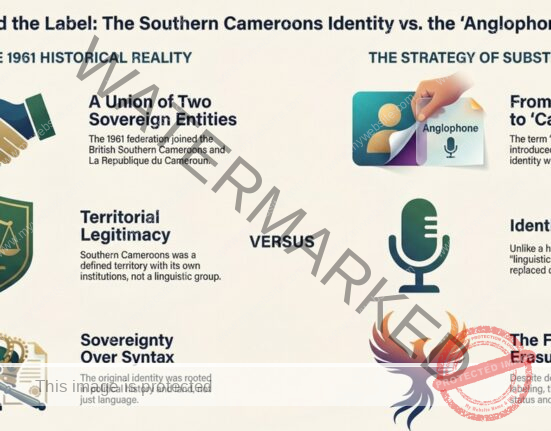
To be fair, Foncha might have acted out of ignorance, believing in the honesty and goodwill of French-backed statesmen who promised partnership and mutual progress. But history later proved that promise hollow. What began as faith in cooperation became submission through deceit. The result was tragic: Southern Cameroons lost its sovereignty not by defeat in war, but by a handshake laced with hidden clauses
By Mankah Rosa Parks, Senior Investigative Correspondent, The Independentist
When history repeats itself, it rarely announces its arrival. It usually comes disguised as progress.
What Southern Cameroonians witnessed in 1961 — the slow betrayal of full independence through misplaced trust and colonial deception — now seems to be replaying itself in Cameroon’s current political theatre, this time under the glittering banner of Project C for Cameroon.
The Echo of 1961
In the years leading up to independence, Dr E. M. L. Endeley championed the idea of a sovereign Southern Cameroons — a small but self-reliant republic charting its own course apart from both Nigeria and La République du Cameroun. But John Ngu Foncha, then Prime Minister, drifted from that vision. Instead of consolidating unity with Endeley to build a confident new nation, he leaned toward Ahmadou Ahidjo’s French-backed call for “integration.”
To be fair, Foncha might have acted out of ignorance, believing in the honesty and goodwill of French-backed statesmen who promised partnership and mutual progress. But history later proved that promise hollow. What began as faith in cooperation became submission through deceit. The result was tragic: Southern Cameroons lost its sovereignty not by defeat in war, but by a handshake laced with hidden clauses. Today, more than sixty years later, we know the full story — and we cannot be deceived again.
A Familiar Plot in 2025
Fast-forward to 2025, and another version of that same playbook is unfolding. Eric Chinje, a former World Bank communication specialist, has become the face of a new political initiative called Project C for Cameroon. In a viral video, Chinje confidently announced that Issa Tchiroma Bakary — a long-time insider of Paul Biya’s regime — “has won with more than 60 percent and will take oath as Cameroon’s third president.”
The declaration came on the very day the National Assembly re-inaugurated Biya for his eighth mandate. Official results, however, tell another story: Biya 53.6 percent, Tchiroma 35.1 percent. The contradiction has left many wondering — is this genuine change, or just another illusion wrapped in slogans of renewal?
Continuity Disguised as Renewal
On paper, Tchiroma’s resurgence looks like rebellion against the old guard. But beneath the surface, the same architecture of power remains — the same institutions, the same elite networks, and the same silence toward the Anglophone question.
The slogans of “transition” and “new Cameroon” sound eerily familiar, echoing Foncha’s faith in Ahidjo’s false federation — a polite partnership that became a political trap. By proclaiming victory before validation, Project C does not challenge the system; it rehearses to inherit it.
The Ambazonian Perspective
For Ambazonians, these developments are not distant curiosities. They are reminders of how history manipulates the hopeful. Every time Yaoundé changes faces, Ambazonia is told to wait — as though a new president could somehow wash away the crimes of occupation.
Dr Samuel Ikome Sako, President of the Government of the Federal Republic of Ambazonia, clarified the national position in precise terms: “Whether it is Paul Biya, Issa Tchiroma, or anyone else, the truth remains that Ambazonia and Cameroon are two distinct nations.
No election held under Cameroonian law can extend authority over a people who voted in 1961 to join only in a federation that was later abolished by deceit. Ambazonia does not recognise the colonial continuity of Yaoundé — and no cosmetic change of faces will alter that legal and moral fact.” His words speak not from bitterness, but from principle. Ambazonia’s struggle is not about who rules Cameroon; it is about ending Cameroon’s rule over Ambazonia.
The Pattern That Refuses to Die
Just as Foncha’s misplaced trust in Ahidjo derailed the Southern Cameroons dream of self-rule, today’s reformist slogans risk reproducing the same deception — change without justice, and progress without truth. Cameroon’s political establishment may once again convince the world that a new dawn has come, while keeping the colonial-unitary structure intact. Western diplomats may applaud a “peaceful transition.” The same applause once greeted the 1961 Foumban Conference — another theatre of false reconciliation. But for Ambazonians, who have endured massacres, exile, and burnt villages, this new show looks painfully familiar.
The Real Issue
The question is not who takes the oath in Yaoundé.
The question is why Ambazonia’s right to self-determination remains hostage to the political dramas of another country. As long as one nation rules another without consent, no election in the occupying power’s capital can be legitimate for the occupied. And as Dr Sako reminded the world, “no cosmetic change of faces will alter that legal and moral fact.”
A Word of Caution
Change without justice is only succession.
Reform without recognition of truth is only the rebranding of oppression. Unless Cameroon confronts the roots of its colonial system — and acknowledges Ambazonia’s right to choose its destiny — every new president will merely repaint the same broken wall. And unless Ambazonians stay vigilant, history may once again repeat itself — this time not through ignorance, but through indifference.
Mankah Rosa Parks, Senior Investigative Correspondent.


Leave feedback about this