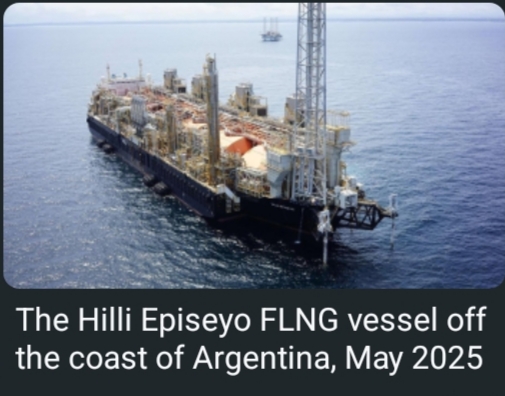


Resources controlled by unaccountable institutions can leave a people as poor as they were before extraction began. The Hilli Episeyo is leaving because another country prepared a future for it. Ambazonia must prepare a future for its gas. The vessel can sail away. The lesson must remain.
By Ali Dan Ismael
Editor-in-chief The Independentist News
A floating industrial complex that helped transform La République du Cameroun into a liquefied-natural-gas exporter is preparing to leave after eight years of nearly uninterrupted production.
The departure of the Hilli Episeyo should have marked the orderly completion of one phase of a national gas-development strategy and the beginning of another. The vessel could have been replaced, retained, or redeployed to another producing basin. Its operations could have been linked more deliberately to electricity generation, fertilizer production, petrochemicals, manufacturing, domestic cooking gas, and industrial development.
Instead, the vessel’s departure is exposing something far more troubling: a state rich in natural gas but poor in institutional coordination; a national hydrocarbons corporation unable to convert temporary extraction into permanent industrial capacity; and a centralized system that exports strategic resources while repeatedly postponing the development of the territory from which much of that wealth originates.
On July 2, 2026, Africa Intelligence reported that the end of the Hilli Episeyo operation was not caused solely by declining reserves in the Sanaga South and Ebomé fields. According to the publication, an effort to redeploy the vessel to the Rio del Rey Basin failed amid obstacles within the gas sector and increasing tension between the state-owned Société Nationale des Hydrocarbures—SNH—and Perenco.
The complete details of the commercial disagreement have not been publicly disclosed by SNH, Perenco, or Golar LNG. It would therefore be irresponsible to invent contractual facts that remain confidential. But the publicly available record is sufficient to establish a larger conclusion:
The end of the project was foreseeable.
The need for replacement gas was known.The Rio del Rey opportunity had been studied for years. The importance of extending floating LNG production had been publicly acknowledged by SNH itself. Yet no replacement arrangement was ready when the existing contract expired. That is not simply depletion. It is a failure of strategy. A Successful Industrial Project That the State Failed to Sustain
The Hilli Episeyo was not a failed vessel or an underperforming experiment.
Commercial operations began in 2018 under an agreement involving Golar LNG, Perenco, and SNH. By the first quarter of 2026, Golar reported that the floating plant had maintained 100 percent economic uptime since the beginning of the contract. It had offloaded 152 LNG cargoes and produced approximately 10.55 million tonnes of LNG. Its Cameroonian contract was scheduled to end in July 2026.
The project was technologically significant. The Hilli Episeyo was converted from an LNG carrier into a floating liquefaction facility and became the first converted vessel of its kind to enter commercial service. Anchored offshore Kribi, it allowed natural gas from the Sanaga South and Ebomé fields to be processed and exported without constructing a conventional multibillion-dollar onshore liquefaction complex.
The model was especially suitable for fields that might not have justified an enormous permanent LNG terminal. A floating facility could be positioned close to offshore production, use existing marine infrastructure, and later be transferred when the original reserves became insufficient.
That mobility was one of the project’s principal advantages. SNH understood this. In its own publication following the beginning of LNG production, SNH stated that it was studying an extension of the floating plant’s operations beyond the original eight-year period. It also identified several potential uses of national gas, including a 300-megawatt power plant in Victoria, industrial and mining projects, domestic gas, and natural gas for transportation. SNH declared that its strategy was intended to support industrial development and meet household needs.
The promise was therefore not merely to extract gas for eight years. The promise was to use the temporary LNG platform as the beginning of a broader gas economy. That broader economy was never constructed at the necessary scale. The Vessel Is Leaving Cameroon for Twenty Years Golar has already secured a new future for the Hilli Episeyo.
After disconnecting from its Cameroonian mooring, the vessel is expected to travel to a shipyard in Singapore for upgrading, life-extension work, and modification. It is then scheduled to begin a 20-year deployment in Argentina during the second half of 2027.
Golar estimates that the Argentina contract will generate approximately $285 million in annual adjusted earnings before interest, taxes, depreciation, and amortization, with a projected backlog of about $5.7 billion before possible commodity-price gains.
This comparison should disturb every serious Cameroonian and Ambazonian policymaker. The vessel spent eight productive years off the Cameroonian coast. Argentina has secured it for twenty more. Golar planned the vessel’s next life. Cameroon failed to secure continuity.
Golar appointed contractors, arranged towing vessels, scheduled the shipyard, budgeted approximately $350 million for upgrades, and negotiated a long-term revenue structure. By May 2026, the company had already spent roughly $60 million preparing the transition.
The contrast is unmistakable.
A serious corporation planned beyond July 2026. The state that owned the gas apparently did not. The vessel remained under its Cameroon contract until July 2026 and would travel first to Singapore before beginning Argentine operations in 2027. Rio del Rey Was the Obvious Bridge to the Next Phase. The end of production from the original fields did not necessarily require the end of Cameroon’s floating LNG industry.
The Rio del Rey Basin represented a possible bridge.
Located in the extreme southwestern part of Cameroon’s offshore territory, adjacent to the Niger Delta petroleum system, Rio del Rey is one of the country’s most productive hydrocarbon basins. Geographically, it lies off the coast of the former British Southern Cameroons, close to the Bakassi–Ndian maritime zone and the border with Nigeria.
Perenco has been one of the basin’s dominant operators. In 2023, the company and SNH signed a new 20-year production-sharing contract for its continued development. Perenco reported that the basin accounted for approximately 70 percent of Cameroon’s petroleum production and supported more than 500 jobs. A five-well development campaign began in 2024 at the Kita Eden field in the basin’s northern section.
The basin is mature, but mature does not mean exhausted. Perenco’s commercial model specializes in extending the productive life of older oil and gas assets through redevelopment, infill drilling, infrastructure reuse, and improved reservoir management. SNH and Perenco had also publicly discussed gas development in Rio del Rey long before 2026.
An SNH publication referred to studies for developing Rio del Rey gas, negotiations concerning the extension of the Hilli Episeyo, and efforts to increase LNG production. SNH’s own 2016 annual reporting also stated that Rio del Rey gas was being considered as one of the supply options for a proposed gas-fired power plant of between 300 and 500 megawatts. The opportunity was therefore neither secret nor recently discovered.
The state knew Rio del Rey contained gas. The state knew the Hilli Episeyo contract would expire in 2026. The state knew new reserves or another field would be required. The state knew that floating liquefaction equipment could be relocated. The state knew Victoria required energy and industrial investment.
Yet when the deadline arrived, no Rio del Rey redevelopment arrangement had been completed. What Does It Mean to Say SNH “Foiled” the Strategy? The word “foiled” carries a serious implication. It suggests more than a missed opportunity. It suggests that decisions, delays, institutional rivalry, contractual inflexibility, or a breakdown in cooperation prevented an otherwise viable project from advancing.
The publicly accessible summary of the Africa Intelligence investigation does not reveal every step in the failed negotiations. It reports that the inability to transfer the Hilli Episeyo to Rio del Rey exposed obstacles paralyzing the gas industry and a deteriorating relationship between SNH and Perenco.
Until the parties release the relevant records, the public cannot know with certainty whether the decisive problem involved gas volumes, price formulas, ownership shares, infrastructure costs, production rights, project leadership, government approval, or the division of future revenues.
But the institutional outcome is already visible. No replacement LNG vessel is ready. No permanent liquefaction plant has been completed. The existing unit is leaving. LNG exports are ending. The anticipated Rio del Rey transition did not happen. The government itself reportedly expects oil and gas activity to contract sharply in 2027 before possible new projects produce a recovery in subsequent years. Published summaries place the expected sectoral decline at approximately 24.6 percent.
Whatever occurred inside the negotiations, SNH cannot reasonably present this outcome as strategic success. A national gas strategy must be judged by continuity, value creation, energy security, industrialization, and the capacity to manage predictable transitions.
By those standards, the state failed. From “Historic Partnership” to Strategic Breakdown The deterioration is particularly significant because SNH and Perenco have repeatedly presented themselves as longstanding partners.
In July 2024, Perenco announced the first delivery of gas from the Bipaga Processing Centre to the Keda Ceramics factory. A six-kilometre pipeline constructed and operated by SNH supplied fuel to the factory’s electrical generators and industrial kilns. Perenco described the project as part of a “fruitful and historic partnership” with SNH and cited both the Rio del Rey production-sharing agreement and the joint Hilli Episeyo operation as examples of successful cooperation. The Keda arrangement demonstrates what gas can accomplish when it is tied directly to industry.
Gas becomes electricity. Electricity and heat become manufactured tiles. Manufacturing creates employment. Local production replaces imports. Energy infrastructure stimulates transport, services, construction, skills, and supply chains. That is the difference between merely exporting a resource and using it to transform an economy.
Yet the scale remains modest compared with the opportunity. The Keda plant was expected to consume up to six million standard cubic feet of gas per day and create approximately 2,000 direct and indirect jobs in the Kribi area. It is an important project, but it is not a substitute for a national system of gas pipelines, power plants, fertilizer production, petrochemicals, industrial parks, and household distribution. The deeper question is why cooperation could support LNG exports and a limited industrial pipeline but could not secure the next phase of floating liquefaction.
Exporting Gas Without Building a Gas Economy
The Hilli Episeyo exposed the weakness of the country’s development model. La République du Cameroun became an LNG-exporting state, but it did not become a fully developed gas economy. An LNG exporter extracts gas, liquefies it, loads it onto ships, and receives revenue. A gas economy uses gas to transform domestic production.
It supplies reliable electricity. It powers factories.It produces fertilizer. It supports cement, ceramics, glass, steel, and food processing. It produces LPG for households. It supports petrochemical industries. It provides feedstock for methanol, ammonia, plastics, and other manufactured products. It helps reduce the burning of firewood and charcoal. It can support cleaner transport and stabilize an electricity system increasingly dependent on hydropower variability.
Cameroon’s proven natural-gas resources have been estimated at more than six trillion cubic feet. Yet a large reserve is not the same as a national strategy. Gas in the ground has little developmental value unless competent institutions connect reserves to infrastructure, markets, industry, electricity, and public welfare.
SNH’s own declared objective was to use gas for industrial development and household needs. But much of the country still lacks reliable electricity. Domestic industries remain constrained by high energy costs. Households continue to face shortages and high prices for cooking gas. The long-discussed gas-fired power plant in Victoria has not materialized. Meanwhile, millions of tonnes of LNG have left the coast for foreign markets.
This is the central contradiction. The resource was monetized.The society was not sufficiently transformed. Victoria Was Promised Gas-Fired Industrial Power For Ambazonians, one of the most important pieces of the record is the proposed gas-fired power station in Victoria.
SNH publicly identified the supply of natural gas to a 300-megawatt power plant in Victoria as one component of its gas-development strategy. Earlier technical assessments considered a plant of between 300 and 500 megawatts, supplied either from the Etinde field or from Perenco-operated fields in Rio del Rey.
Such a plant could have transformed the economy of the Atlantic region. It could have supplied Victoria, Tiko, Buea, Muyuka, Kumba, Mundemba, Ekondo Titi, Mamfe, and other communities through a strengthened regional grid. It could have supported SONARA’s eventual reconstruction and modernization.
It could have powered port development, cold-storage facilities, fisheries, agricultural processing, cement production, digital infrastructure, manufacturing, and industrial parks. It could have reduced pressure on an unreliable national electricity system. It could have provided productive use for Rio del Rey gas that might otherwise be flared, reinjected, stranded, or exported.
Instead, the project has remained largely a promise. The gas exists offshore. The markets exist onshore.The communities need electricity. The industrial possibilities are obvious. What has been missing is state execution.
The Rio del Rey question cannot be separated from the constitutional and economic relationship between Ambazonia and La République du Cameroun.
The basin lies off the southwestern coast in an area historically and geographically connected to Southern Cameroons. Yet licensing, production agreements, revenue collection, project approval, and strategic decisions are controlled by institutions based in Yaoundé.
Local communities have little meaningful authority over the pace of development, the selection of operators, environmental regulation, revenue allocation, or the use of the gas produced near their coastline.
This creates a familiar colonial pattern. The resource is local. The authority is external. The revenue disappears into centralized accounts. The environmental risk remains near the producing communities. The industrial infrastructure is frequently built elsewhere. The population is informed after decisions have already been made.
The failure to redeploy the Hilli Episeyo is therefore not only an energy-policy problem. It is another example of how excessive centralization can destroy value.
A distant bureaucracy may possess formal authority while lacking local accountability, urgency, technical continuity, or a genuine commitment to regional development.
Had the coastal territory possessed meaningful control over its gas strategy, the negotiations might have been guided by different priorities:
How can Rio del Rey gas provide reliable electricity to the Atlantic and Midland regions? How can gas support the reconstruction of Victoria as an industrial and maritime city? How can local workers be trained for offshore engineering, pipeline construction, LNG operations, maintenance, environmental monitoring, and petrochemical production?
How can revenue be converted into schools, hospitals, roads, water systems, and productive investment? How can local governments and affected communities participate in environmental oversight? These questions are secondary under a centralized extractive system. They must become primary in a future Ambazonian republic. Was Continued LNG Export the Best Use of the Gas?
The failure to retain the Hilli Episeyo should not lead automatically to the conclusion that every available unit of Rio del Rey gas ought to have been liquefied for export.
That question requires an honest economic evaluation. LNG exports can generate foreign currency and public revenue. A floating plant can also commercialize offshore fields that might otherwise remain stranded. But LNG requires expensive processing, marine logistics, long-term buyers, and competitive production costs.
Domestic uses may sometimes generate greater long-term value. Gas supplied to a power plant can support thousands of businesses. Gas used in fertilizer production can improve agricultural productivity and reduce food-import dependence. Gas supplied to industrial parks can attract manufacturing. LPG can reduce household dependence on wood and charcoal. Petrochemicals can create higher-value exports than raw or liquefied gas alone.
The national failure was therefore not necessarily the loss of one vessel. The greater failure was the absence of a transparent plan showing how Rio del Rey gas would be allocated among exports, electricity, industry, cooking fuel, petrochemicals, and strategic reserves. A state should not pursue LNG merely for prestige. Nor should it abandon LNG without an alternative. It should choose the combination that produces the greatest national value.
The Questions SNH Must Answer
SNH should provide the public with a complete explanation of what happened. The questions are straightforward.
When did negotiations concerning the possible redeployment of the Hilli Episeyo to Rio del Rey begin? What volumes of commercially recoverable gas were identified? What infrastructure would have been required to connect Rio del Rey production to the vessel? Which institution was expected to finance that infrastructure? What commercial terms were proposed by Golar, Perenco, and SNH? Why did the negotiations fail? Was the presidency directly involved? Did disagreements concern pricing, ownership, project control, revenues, or production rights?Did SNH reject terms considered commercially excessive, or did it delay decisions until Golar secured a more attractive offer elsewhere? What alternative LNG facility was considered? Why was no replacement vessel contracted? What is now planned for Rio del Rey gas? Will the gas be supplied to Victoria? Will it be used for electricity, domestic industry, LPG, fertilizer, or petrochemicals? How much public revenue will be lost when LNG exports cease? What will happen to workers and contractors connected to the floating LNG operation? Without answers, “national strategy” becomes merely a phrase used to conceal institutional failure.
The Relationship With Perenco Requires Scrutiny, Not Slogans Perenco is a private petroleum company acting in its commercial interest. It should not be romanticized as a charitable development partner. Nor should every disagreement with SNH automatically be interpreted as proof that the company is right and the state is wrong.
The company seeks profitable reserves, favorable contracts, operational control, and returns on investment. That is what private companies do. SNH’s responsibility is different. It is supposed to defend the public interest.
That requires competent negotiation, independent technical capacity, transparent accounting, environmental protection, and a clear plan for converting hydrocarbons into national development.
A strong state company should be capable of negotiating firmly without paralyzing projects. It should protect national value without driving away technology and investment. It should avoid dependence on a single private operator while maintaining credible commercial relationships.
The reported deterioration between SNH and Perenco may therefore reveal failure on several sides. Perenco may have demanded terms the state considered unacceptable. SNH may have allowed personal, institutional, or political conflict to obstruct a commercially viable transition. The presidency may have interfered. The parties may have disagreed over control of the next phase. The public does not yet know. What can be said is that secrecy protects the institutions and corporations involved while leaving citizens to absorb the consequences.
An Ambazonian Gas Sovereignty Doctrine
Ambazonia must learn from this failure.A future republic should not treat natural gas merely as another commodity to be exported through opaque agreements. It should adopt a Gas Sovereignty Doctrine grounded in ownership, transparency, industrialization, environmental protection, and intergenerational responsibility.
Such a doctrine should begin with a complete, independently verified inventory of gas resources in Rio del Rey, Etinde, the Mamfe Basin, and other prospective zones. Every production-sharing agreement should be subject to professional legal, economic, engineering, and environmental review. The beneficial owners of all participating companies should be disclosed.
Gas should be allocated according to a transparent hierarchy of national priorities: First, reliable electricity. Second, domestic industry. Third, household LPG and clean cooking. Fourth, fertilizer and agricultural transformation. Fifth, petrochemical manufacturing. Sixth, strategic reserves and regional energy security. Exports should remain important, but they should not take automatic precedence over domestic transformation.
The republic should also establish an independent hydrocarbons regulator separate from the national commercial oil and gas company. One institution should not simultaneously represent the state as shareholder, negotiate contracts, regulate operators, supervise environmental compliance, and account for revenue. That concentration of authority creates conflicts of interest and weakens public oversight.
A sovereign wealth and transformation fund should receive a legally defined share of petroleum and gas revenues. Withdrawals should be audited, published, and restricted to infrastructure, education, industrial development, environmental restoration, and intergenerational investment.
Producing communities should receive enforceable benefits rather than discretionary gifts. Technical colleges should train pipeline welders, instrumentation specialists, marine engineers, geologists, process engineers, safety officers, environmental scientists, and LNG technicians. Gas should become human capital. Gas should become electricity. Gas should become industry.Gas should become national wealth.
The Lesson Is Larger Than One Vessel The Hilli Episeyo will leave. The vessel will be upgraded. Argentina will receive twenty years of liquefaction capacity. Golar will continue earning revenue. Perenco will pursue opportunities elsewhere or continue developing fields under agreements it considers commercially viable. SNH will issue explanations, studies, and future projections. But Cameroon will lose its only operational LNG-export platform without an immediate replacement. That is the undeniable outcome.
The vessel’s departure demonstrates why possession of natural resources does not guarantee development. Development depends upon institutional foresight, contract management, infrastructure planning, technical competence, continuity of policy, and public accountability. The gas did not fail. The technology did not fail. The vessel did not fail. The failure was institutional.
Conclusion: The Gas Was Temporary, but the Failure May Be Permanent
The Hilli Episeyo arrived as a symbol of technological innovation and national ambition. It demonstrated that offshore gas fields could be commercialized without waiting for a conventional onshore LNG megaproject. It maintained an exceptional operating record, exported more than ten million tonnes of LNG, and placed Cameroon among the world’s gas-exporting states. But the project was always temporary.
A serious state would have used those eight years to prepare the next reserves, negotiate the next facility, construct the next pipelines, train the next generation of technicians, expand domestic gas use, and establish a permanent industrial ecosystem.
Instead, the expiry date arrived before the strategy did. The reported failure to transfer the operation to Rio del Rey reveals the danger of governing natural resources through secrecy, personal authority, institutional rivalry, and centralized control.
For Ambazonians, the lesson is even clearer. The Rio del Rey Basin is not merely a geological formation on an SNH map. It is part of Ambazonia’s maritime and economic inheritance. Its gas could power homes. It could rebuild Victoria. It could support SONARA. It could create fertilizer, ceramics, glass, cement, chemicals, cold storage, and manufacturing. It could train engineers and employ young people. It could finance infrastructure and future generations. But none of this will happen automatically.
Resources controlled by unaccountable institutions can leave a people as poor as they were before extraction began. The Hilli Episeyo is leaving because another country prepared a future for it. Ambazonia must prepare a future for its gas. The vessel can sail away. The lesson must remain.
Ali Dan Ismael
Editor-in-chief The Independentist News