











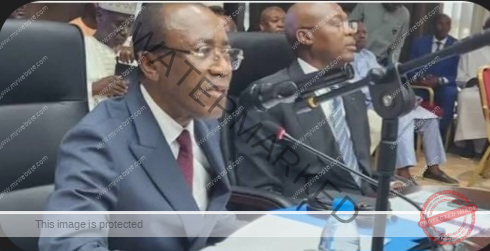
Responding to growing concern over the discrepancies, Secretary of State at the Ministry of Mines, Industry and Technological Development, Calistus Fuh, acknowledged the seriousness of illicit gold flows and indicated that reforms are underway to address the problem.
By Ali Dan Ismael and Timothy Enongene London bureau
The Gold Export Mystery
Recent trade and mining transparency reports, have drawn attention to a striking anomaly in Cameroon’s gold sector: while official national export declarations show only minimal quantities of gold leaving the country, import records in the United Arab Emirates—especially Dubai—indicate that approximately 15 tonnes of gold attributed to Cameroon entered the UAE in a single year.
This discrepancy has fueled growing debate within Cameroon and across the diaspora about who benefits from this undeclared gold flow, and whether political elites are quietly moving wealth abroad amid mounting uncertainty over the country’s political future.
Dubai: The Global Gateway for African Gold
Dubai, over the past decade, has become one of the world’s principal hubs for African gold. Investigations and international NGO reports have repeatedly shown that gold from artisanal and small-scale mining operations across Africa often bypasses official export channels, moving instead through informal or smuggling networks before reaching UAE refineries and markets.
Such flows deprive producing countries of taxes, royalties, and development funds while enriching intermediaries and networks connected to political and commercial power.
Cameroon’s Governance Gap
In Cameroon’s case, the gap between official export data and import figures suggests that substantial gold production is leaving the country outside formal state accounting systems. Analysts note that such patterns typically occur where governance oversight is weak and political patronage networks control access to mining zones and export routes.
Capital Flight and Political Uncertainty
The situation has inevitably produced speculation about the motivations behind such capital movement. Some commentators argue that, as succession questions loom around Cameroon’s long-standing political order, influential figures within the ruling elite may be seeking to secure financial assets abroad as insurance against instability.
In politically fragile environments, moving wealth into portable, high-value forms such as gold—and placing them in international financial hubs—is a common hedge against regime change or economic crisis.
Ethnic Politics and Resource Narratives
Within Cameroon’s ethnically sensitive political discourse, these developments have also been interpreted through regional and identity lenses. Critics of the ruling establishment often describe power as concentrated within networks associated with the Beti-Bulu political elite.
In that context, some voices speculate that capital flight could eventually underpin regional economic security should national political arrangements fracture in the future. However, such interpretations remain political commentary rather than documented policy direction.
Separating Evidence from Allegation
It is important to distinguish between verified trade discrepancies and unproven allegations involving specific individuals or political projects. While the data supports concerns about large volumes of gold leaving Cameroon outside official channels, there is no publicly documented evidence confirming that named senior figures personally transported gold shipments or that such movements are part of an organized plan to establish an independent regional economic base.
Government Response and Reform Efforts
Responding to growing concern over the discrepancies, Secretary of State at the Ministry of Mines, Industry and Technological Development, Calistus Fuh, acknowledged the seriousness of illicit gold flows and indicated that reforms are underway to address the problem.
According to ministry communications, government measures aim to improve traceability in artisanal mining, strengthen oversight of buying and export channels, and ensure that gold production benefits national revenue rather than disappearing through informal networks.
The Economic Cost to the Nation
What remains clear is the economic consequence: Cameroon appears to be losing significant mining revenue at a time when public finances are strained and development needs are acute. Funds that could support infrastructure, schools, energy generation, or healthcare instead vanish into opaque international trading networks.
The question facing Cameroon.
Whether announced reforms succeed will depend on political will, enforcement capacity, and transparency in the management of natural resources.
For many Cameroonians, the controversy ultimately raises a broader question: can a country struggling with conflict, unemployment, and underdevelopment afford continued leakage of one of its most valuable mineral resources?
Until mining governance improves, the mystery of Cameroon’s missing gold—and the political narratives surrounding it—will likely persist.
Ali Dan Ismael and Timothy Enongene in London



Leave feedback about this