












Ambazonia does not exist because people speak English. It exists because a people were denied the right to complete their decolonization. Reducing that reality to an “Anglophone crisis,” misusing the language of open diplomacy, and substituting prayer and visibility for statecraft mobilize attention but dissolve legitimacy.
By Ali Dan Ismael and Mankah Rosa Parks, the Editorial Desk
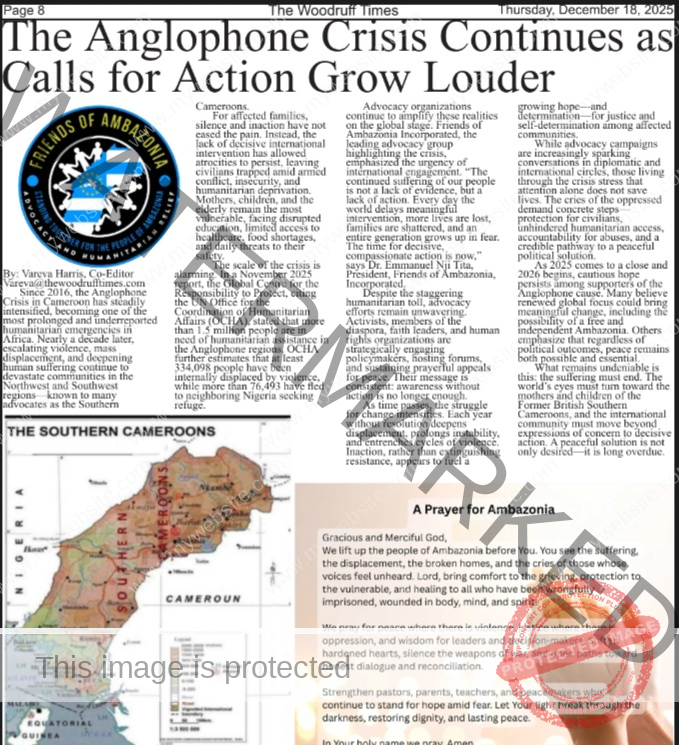
Attention Is Not Legitimacy, As published in The Woodruff Times, the article by Vareva Harris succeeds in mobilizing attention. It evokes sympathy, circulates widely, and reinforces humanitarian concern. But attention is not legitimacy. Advocacy can amplify visibility; it does not confer political authority, legal standing, or diplomatic weight.
Over time, figures associated with this advocacy space—Professor Richard Mbih, Emmanuel Tita, Kizito Elad, Irene Ngwa, Paul Bassa Nillong, Dorothy Ngwa, and Pastor Victor Mbah—have promoted a narrative that substitutes “Anglophone marginalization” for Ambazonian statehood. This framing redirects international attention away from decolonization and toward minority accommodation, mobilizing sympathy while quietly dissolving the legal basis of independence.
Diplomacy Exists — And It Is Being Ignored
Contrary to the implication that Ambazonia lacks political agency, the Federal Republic of Southern Cameroons, Ambazonia has pursued sustained diplomatic engagement. These efforts include formal representations to international bodies, legal submissions asserting the territory’s decolonization status, outreach to state and non-state actors, and the articulation of a clear political objective grounded in international law.
This diplomacy is purposeful. It seeks recognition, mediation anchored in law, and remedies consistent with self-determination—not humanitarian substitution for sovereignty. The article omits these efforts entirely, reinforcing a false impression of political absence and replacing an ongoing legal struggle with a narrative of perpetual victimhood.
Friends of Ambazonia Has Withdrawn From the Diplomatic Struggle
It must be stated plainly that Friends of Ambazonia has removed itself from the fight diplomatically and otherwise. Its current posture—focused on humanitarian messaging, linguistic framing, and advocacy spectacle—no longer advances the legal or diplomatic objectives of Ambazonian statehood. Mobilizing attention is not the same as prosecuting a case; the former may attract sympathy, but the latter secures rights.
The Misuse of “Open Diplomacy” and the Naivete It Reveals
Compounding this retreat is a persistent misuse of the concept of “open diplomacy.” Public-facing advocacy, social media declarations, open letters, and prayer-led broadcasts are treated as substitutes for statecraft. They are not. Open diplomacy does not mean unstructured exposure, public bargaining, or the outsourcing of negotiation to sentiment. Effective diplomacy is disciplined, sequenced, confidential where necessary, and grounded in mandate. The conflation of visibility with leverage reveals a troubling naivete within segments of civil society leadership—an assumption that transparency and piety alone compel outcomes. They do not.
This misuse is exemplified by elevating prayer as a diplomatic instrument. Evangelism is introduced where legal briefs, mandates, and negotiations should stand. Faith may sustain morale; it does not create standing, confer authority, or negotiate remedies. When prayer replaces policy and devotion substitutes for dossiers, the result is not diplomacy—it is abdication.
Sincerity Is Not Strategy
The article is sincere and emotioally compelling. It documents suffering accurately and amplifies pain that the world has too often ignored. But sincerity is not strategy, and compassion without political clarity does not liberate nations. As a plea for Ambazonian independence, the article falls short—not because it lies about suffering, but because it misidentifies the political problem from the outset and sidelines the diplomacy required to resolve it.
There Is No Anglophone Problem
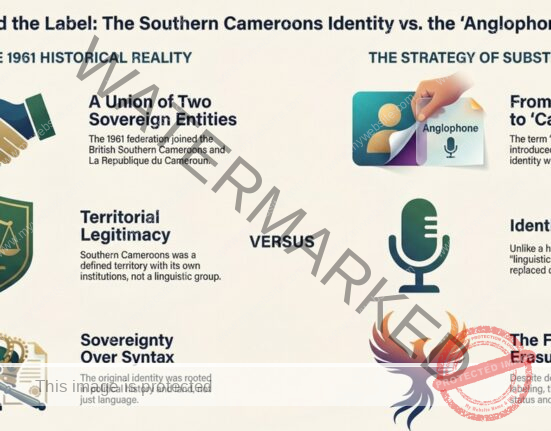
The continued reliance on the phrase “Anglophone Crisis” is a categorical error. There is no Anglophone problem in international law, in decolonization doctrine, or in the political history of Southern Cameroons. “Anglophone” is a linguistic descriptor, not a people, not a polity, and not a subject of self-determination. Languages do not possess territorial rights. Peoples do. Ambazonia is not a linguistic minority within Cameroon; it is a former British trust territory whose decolonization was never lawfully completed. Framing the conflict as “Anglophone” collapses a territorial, legal dispute into a cultural grievance and mirrors the occupier’s preferred narrative.
The Anglophone Lexicon Does Not Exist in the Nineteen Sixty-One Order
The article’s language is historically and legally disconnected from the foundation of the dispute. The word “Anglophone” appears nowhere in the nineteen sixty-one plebiscite framework, nowhere in the constitutional instruments governing the fate of Southern Cameroons, and nowhere in the United Nations documentation that transferred authority. The political choice presented in nineteen sixty-one was not about language rights; it was about territorial destiny. Importing the Anglophone lexicon into a decolonization question retroactively rewrites history and strips Ambazonia of its legal personality.
Language Is Jurisdiction
Words define standing. By calling Ambazonia an “Anglophone region,” the article implicitly accepts Cameroon’s sovereignty over the territory and reduces Ambazonians to a disgruntled cultural subgroup. You cannot argue for independence while borrowing the occupier’s dictionary. This is not semantics; it is jurisdiction.
Unfocused Narrative, Insufficient Facts for Diplomac
Beyond terminology, the article lacks the focus and evidentiary discipline required for diplomacy. It moves between humanitarian concern, advocacy rhetoric, prayer, and speculative political outcomes without anchoring its claims in verifiable legal facts, instruments, or precedents. Diplomacy operates on precision—dates, resolutions, legal defects, and clear demands. An unfocused narrative may mobilize sympathy; it cannot compel recognition, arbitration, or enforcement.
A Humanitarian Appeal Is Not a Political Case
The article treats humanitarian suffering as though it were itself the argument for independence. It is not. Suffering explains urgency; it does not establish sovereignty. Independence arises not from pain, but from the absence of lawful consent. Without grounding the struggle in self-determination, decolonization, and violated international process, the article unintentionally converts Ambazonia into a permanent humanitarian project rather than a political claimant.
The Missing Law
No serious independence claim survives without law, and the article contains none. There is no reference to the UN-supervised plebiscite of nineteen sixty-one, no mention of the absence of a valid treaty of union, no engagement with the legal distinction between federation and annexation, no invocation of remedial self-determination, and no comparison to international precedents. Courts do not adjudicate on prayers, and states do not redraw borders on sympathy.
Prayer Is Not a Political Program
Faith may sustain a people; it does not negotiate borders. When prayer is elevated to diplomacy, the claim to sovereignty is weakened, not strengthened.
Undefined Action Preserves the Status Quo
Calls for “decisive action” are repeated without defining who must act, under what authority, or toward what political end. This ambiguity permits statements of concern and endless dialogue without confronting sovereignty.
Conclusion: Ambazonia Is Not an Anglophone Mood
Ambazonia does not exist because people speak English. It exists because a people were denied the right to complete their decolonization. Reducing that reality to an “Anglophone crisis,” misusing the language of open diplomacy, and substituting prayer and visibility for statecraft mobilize attention but dissolve legitimacy. Compassion may awaken conscience, but only clarity of language, clarity of law, factual discipline, and disciplined diplomacy can deliver liberation.
Ali Dan Ismael and Mankah Rosa Parks The Independentistnews editorial desk



Leave feedback about this