












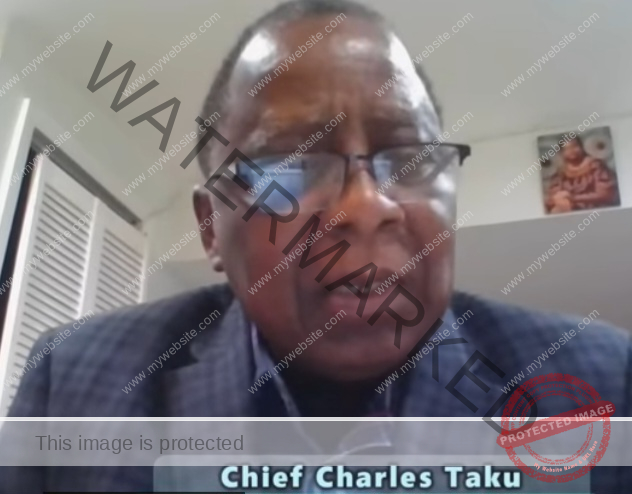
In his VOA interview, senior barrister Charles Taku began by condemning the illusion of stability promoted by the regime in Yaoundé.
“You cannot bomb a people into unity, nor imprison them into silence,” he said. “The right to self-determination is not a crime — it is a principle of international law.”
By The Independentist Editorial Desk
For Public Education and Awareness
When Chief Barrister Charles A. Taku speaks, he does so with the clarity of law and the courage of truth. A former President of the International Criminal Court Bar Association and one of Africa’s most respected human-rights lawyers, Taku has spent his career confronting injustice — from international tribunals to his homeland of Southern Cameroons, known today as Ambazonia.
In a recent interview with the Voice of America, Chief Taku dissected the ongoing crisis in Cameroon with the precision of a legal surgeon. His remarks come at a moment when French Cameroon’s political climate has grown volatile following Paul Biya’s disputed re-election in October 2025, amid a backdrop of civil war, repression, and a collapsing rule of law. “You cannot bomb a people into unity”
Taku began by condemning the illusion of stability promoted by the regime in Yaoundé. “You cannot bomb a people into unity, nor imprison them into silence,” he said. “The right to self-determination is not a crime — it is a principle of international law.”
He warned that Cameroon’s political temperature is dangerously high and that the ongoing war in Ambazonia has become both a humanitarian disaster and a moral test for the international community.
“For more than eight years,” he told VOA, “the people of Southern Cameroons have been subjected to a war of extermination — entire villages burned, women raped, children executed in schools, and entire communities displaced. Yet the world still calls it a domestic crisis. It is not. It is a crime against humanity.”
The six truths missing from the global conversation
Chief Taku brought out six significant points that have been missing in most international discussions on Cameroon’s crisis:
First, Cameroon has conducted national elections under a declared state of emergency — an illegal and unconstitutional condition that strips the process of any credibility. A government cannot claim to be democratic while simultaneously operating under martial law.
Second, he exposed the militarization of the justice system, where military tribunals now try civilians, journalists, and even political opponents. “When courts become barracks,” Taku said, “justice becomes an instrument of oppression.”
Third, he lamented the total absence of a credible system for free and fair trial. Judges are appointed and dismissed by presidential decree, lawyers are harassed, and verdicts are dictated by the executive. “There can be no peace without impartial justice,” he emphasized.
Fourth, Taku accused foreign interests of deliberately prolonging the conflict because Ambazonia is the gateway to the Gulf of Guinea — a region rich in oil, gas, and strategic shipping routes. “This is not just a war against a people,” he explained. “It is a geopolitical war for control of resources and access to the sea.”
Fifth, he denounced the exploitation of Paul Biya’s advanced age by political and foreign elites who use him as a shield while they continue the genocide in Ambazonia. “The old man is only a mask,” Taku said. “Behind him are networks feeding on war, corruption, and French interests.”
Sixth, Taku revealed that Cameroon’s recent elections were conducted without publishing a credible electoral list, and without any official census of eligible voters. In a country divided by war and mass displacement, millions were either disenfranchised or replaced by fictitious names. “An election without a people,” he said, “is a ritual of deceit.”
The illusion of democracy and the collapse of legitimacy
While Biya’s regime celebrated another “victory” in Yaoundé, vast parts of Ambazonia remained under military occupation. Thousands in Buea, Bamenda, Kumba, and Mamfe could not vote at all. Yet the government still announced turnout figures from towns that have been reduced to ashes. “You cannot speak of national unity,” Taku said, “when half the nation lives in exile or under occupation.” He described the election as theatre performed under the shadow of the gun. The electoral process, he insisted, has lost all moral and legal authority.
The historical truth: occupation, not unification
Taku revisited the roots of the crisis. He reminded the world that the Southern Cameroons gained independence by joining, not by surrendering, in 1961. The UN Resolution 1608 (XV) required a signed treaty of union between the British-administered Southern Cameroons and La République du Cameroun. That treaty was never signed.
“What followed was not unification but annexation,” Taku said. “The legal record is clear — Ambazonia’s statehood was absorbed without consent. That is the original sin that birthed this conflict.”
Since then, Ambazonia’s institutions, culture, and common-law systems have been systematically dismantled. The suppression of its identity, he explained, is what led to the 2016 uprising — now met with military violence instead of dialogue.
War crimes, foreign complicity, and the silence of the world
Over one million people are displaced, and more than fifty thousand have died. Entire villages have been wiped out by French-trained forces loyal to Yaoundé. Taku argues that France’s political, military, and economic involvement makes it complicit in war crimes and crimes against humanity.
“No state can hide behind sovereignty to commit genocide,” he declared. “Silence in the face of atrocity is participation.” He called on the International Criminal Court, the African Commission on Human and Peoples’ Rights, and the UN Human Rights Council to break their silence and hold perpetrators accountable.
The path forward: law, not violence
Taku’s vision is both firm and hopeful. He believes peace will only come through recognition of Ambazonia’s right to self-determination and international mediation grounded in law. The war must end, the truth must be told, and justice must be allowed to speak.
“A political mandate won in darkness cannot govern in peace,” he warns. “Justice is not rebellion; it is the foundation of peace.” For the people of Ambazonia — from the home front to the diaspora — Taku’s voice remains a compass of courage and conscience.
History will not remember those who hid behind neutrality. It will remember those who stood up and said: A people have a right to live free — and no empire, French or otherwise, can bomb that truth away.
The Independentist Editorial Desk


Leave feedback about this