


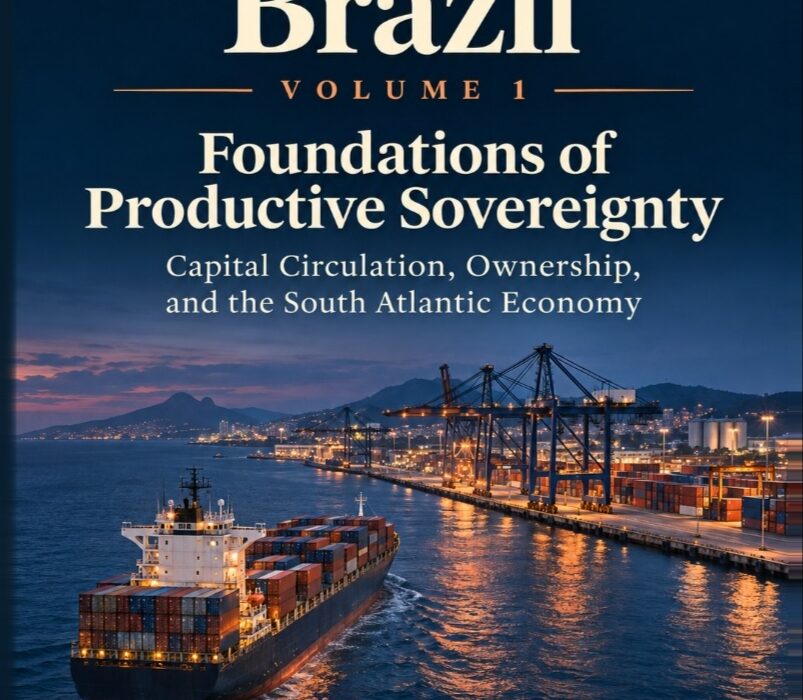


By The Independentist News Book Review.
As Amazon associate this site earns from qualifying purchases
Follow the link below to get copies of publications touching on productive Sovereignty by Martin Mungwa on Amazon
A container leaves an African port carrying a commodity. Another leaves Brazil carrying machinery or processed goods. Both shipments register as trade. But a cargo manifest cannot tell us who owns the technology, who controls the financing, or where the profits will be invested.
Martin S. Mungwa opens Africa and Brazil, Volume 1: Foundations of Productive Sovereignty with this scene. It sets up the book’s central question: What does a country gain from trade that it can still use when the deal is over?
Mungwa calls that capacity productive sovereignty. In practice, it means that local firms can maintain equipment, negotiate with lenders and buyers, train new workers, and keep production going when a foreign partner departs.
The book is at its strongest when Mungwa brings an engineer’s eye to these arrangements. A project may create jobs and meet its export targets while depending on a software license that can be withdrawn, a single buyer that dictates terms, or a maintenance team that nobody locally can replace. Those dependencies rarely appear in a press release. They can determine whether the enterprise survives.
Follow the banana, then follow the money
The banana example makes the argument concrete. A grower can produce an excellent crop and still struggle to finance the next planting. The decisive questions extend beyond the farm: Who sets the grade? Who pays for refrigeration and freight? Who has access to affordable credit? Who can afford to wait when a payment is late? Following the banana through those transactions shows where bargaining power sits and where the returns accumulate.
Mungwa applies the same scrutiny to the demand for local processing. A refinery can be built on national soil and still depend on imported expertise, costly power, and a single external buyer. His discussion of cocoa processing makes a less glamorous point with more practical force. A plant may be technically complete and still sit idle because it cannot finance the purchase and storage of enough cocoa to keep operating. For officials weighing an industrial proposal, that distinction can save years and millions.
The book also takes South–South cooperation seriously enough to question it. In its treatment of ProSAVANA, the Japan–Brazil–Mozambique agricultural initiative, it distinguishes the performance of a community-level project from the wider dispute over the master plan. The account asks who defined the problem, whose land rights were at stake, and how much influence farmers had over the design. For a book advocating closer ties with Brazil, that willingness to examine a contested partnership gives the argument credibility.
A demanding test for any partnership
The book is less persuasive when it moves from diagnosing weak deals to proposing institutions that could finance better ones. Mungwa’s proposed South Atlantic financing platform begins sensibly with shared standards for evaluating projects. But the proposal would benefit from a worked example showing how a lender, a government, and local producers would settle a disagreement over currency risk or ownership. The scorecard and diagnostic worksheets make the framework usable. An example built around competing interests would show where those tools have the power to change a deal.
For Ambazonian readers, the book’s immediate relevance lies in the questions it gives communities and negotiators. In any proposed agricultural or infrastructure partnership, who can inspect the contract? Who bears the losses if the project fails? Who owns the equipment, the data, and the customer relationships? What share of the proceeds can finance the next enterprise? Those questions matter when terms are still open and communities have a chance to influence them.
Africa and Brazil, Volume 1 deserves to be read before the next trade mission or investment announcement. Its most valuable contribution is a test that any reader can apply: when the foreign partner leaves, what can local people still operate, repair, improve, and finance? A deal’s answer to that question tells us more about its development value than the size of the shipment or the promise made at the signing ceremony.
As Amazon associate this site earns from qualifying purchases
Follow the Link below and get copies of publications touching on productive Sovereignty by Martin Mungwa on Amazon
The Independentist News Book Review.