











If Mr. Fru wishes to argue that UN documentation strengthens the legal narrative, that is reasonable. If he contends it should inform diplomatic strategy, that is defensible. But to assert that it is the sole legitimate path—and that all alternative approaches empower the occupier—is strategically unsound.
The Independentist News Editorial by Ali Dan Ismael Editor-in-Chief.
Context: Roland Fru’s 27 February 2026 Presentation
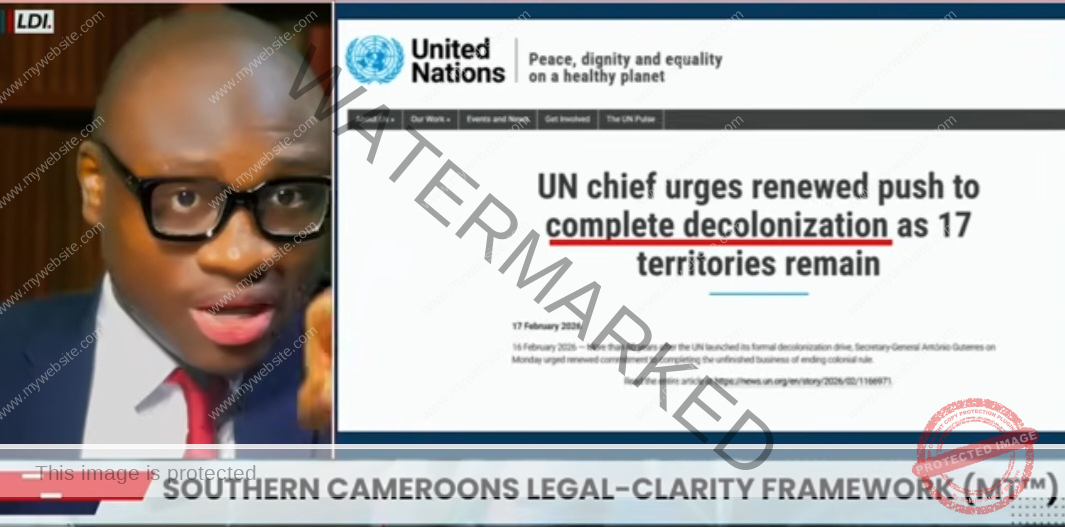
On 27 February 2026, Mr. Roland Fru delivered a social media presentation asserting that the only legitimate path to Ambazonian liberation lies in the completion of what he describes as an “incomplete” United Nations decolonization process. His argument centers on the Trusteeship framework under Chapter XII of the UN Charter and UN General Assembly Resolution 1608 (XV), which he interprets as evidence that the decolonization of Southern Cameroons was never lawfully concluded.
The presentation was forceful. It was confident. It was absolute. But absolutism in national strategy demands scrutiny. This editorial responds not with emotion, but with structural analysis.
Interpretation vs. Institutional Verdict
It is entirely legitimate to study the UN Charter. It is responsible to examine Resolution 1608 (XV). Serious movements ground themselves in documentary history. However, the claim that the United Nations has issued a binding ruling declaring the decolonization process legally incomplete is inaccurate. No standing UN resolution presently affirms that trusteeship obligations remain open.
The argument advanced by Mr. Fru is a legal interpretation—one shared by some advocates—but it is not an institutional verdict. There is a fundamental difference between interpretation and adjudication. Presenting a contested legal theory as settled jurisdictional fact risks misleading the public and narrowing strategic thinking.
The Problem of Strategic Exclusivity
Mr. Fru frames his approach as exclusive. According to his presentation, deviation from his UN procedural pathway amounts to enabling occupation. That framing is coercive and strategically flawed.
Liberation movements historically succeed through layered strategies: legal action, diplomatic engagement, coalition-building, international advocacy, economic leverage, and—where appropriate—structured negotiation. These tracks are not mutually exclusive. They reinforce one another. Declaring one procedural route as “the only path” does not create clarity; it creates rigidity. In a geopolitical system defined by complexity and competing interests, rigidity weakens leverage.
Institutional Depth vs. Intellectual Centralization
In his presentation, Mr. Fru suggested that lawyers cannot manufacture the case and that he must guide them because they cannot understand it as he does. It is true that lawyers cannot invent facts. But no national movement should depend on a single individual as intellectual gatekeeper.
Sustainable struggles build institutional depth: legal committees, documentation teams, diplomatic corps, research units, and transparent advisory structures. If a strategy collapses without one interpreter, it is not institutionalized. It is centralized. And centralization creates vulnerability.
The Political Reality of the United Nations
The UN system is not an automatic enforcement mechanism. It is a political arena shaped by alliances, voting blocs, diplomatic influence, and geopolitical calculations. Procedures move through negotiation among states, not by legal logic alone.
Filing documents without parallel diplomatic groundwork does not generate outcomes; it generates archives. If the UN route is to be pursued, it must be integrated into a broader strategy that includes coalition-building among member states, sustained diplomatic engagement, narrative shaping, and regional alliances. Without these, procedural submissions risk stagnation.
Negotiation, Leverage, and Multiplicity
Mr. Fru’s doctrine appears to reject negotiation frameworks outright. Yet international actors—whether states, regional organizations, or multilateral bodies—operate within a system built on recognition and negotiated settlements.
Negotiation without leverage can entrench the status quo. That concern is legitimate. But rejecting negotiation entirely while concentrating national energy into a slow-moving procedural channel does not increase leverage; it narrows it. Leverage is built through multiplicity, not exclusivity.
Fundraising and Accountability
Research and legal advocacy require resources. Supporting such initiatives is not inherently problematic. However, financial appeals must be accompanied by transparency, measurable benchmarks, institutional oversight, and documented progress.
Framing donations as moral proof of loyalty to “the only path” is unhealthy. National liberation cannot be reduced to subscription to a single file or allegiance to one procedural theory. Accountability strengthens movements. Personal conviction alone does not.
Strategic Debate Is Not Betrayal
Perhaps most concerning is the rhetorical implication that dissent from this UN-only doctrine equates to choosing occupation or historical failure. Mature political movements refine strategy through internal critique. Debate is not collaboration. Scrutiny is not sabotage. In fact, strategic evaluation is evidence of seriousness. Suppressing debate in favor of doctrinal purity weakens intellectual resilience.
The Core Strategic Question
The issue is not whether UN Trusteeship history matters. It does. It must be studied, documented, and used where legally viable. The issue is whether that history, standing alone, can sustain a comprehensive national strategy. It cannot.
International law without political leverage is advisory. Documentation without coalition-building is inert. Legal interpretation without enforcement mechanisms remains theoretical.
A Call for Structured Dialogue
None of this analysis should be read as a dismissal of Mr. Fru’s efforts or of the importance of United Nations archival history. On the contrary, serious legal scholarship strengthens national positioning. If Mr. Fru and others possess documentation that advances the legal narrative, that material deserves institutional review, peer examination, and structured integration into a broader strategy.
What is required now is not doctrinal rivalry, but coordinated architecture. A roundtable of legal experts, diplomatic strategists, historians, and policy planners could evaluate the UN pathway alongside parallel tracks and determine how each reinforces the other. The moment calls not for monopoly, but for synthesis.
Conclusion: Beyond Procedural Monopoly
Liberation requires institutional discipline, distributed expertise, diplomatic alliances, economic strategy, narrative coherence, and legal grounding. No single interpretive lane can substitute for a comprehensive architecture.
The struggle cannot be reduced to one man’s file, one reading of one resolution, or one procedural theory presented in a single social media broadcast. If Mr. Fru wishes to argue that UN documentation strengthens the legal narrative, that is reasonable. If he contends it should inform diplomatic strategy, that is defensible. But to assert that it is the sole legitimate path—and that all alternative approaches empower the occupier—is strategically unsound.
The way forward must be institutional, diversified, disciplined, and layered. Sovereignty belongs to the people collectively—not to a procedural monopoly, and not to a single interpreter of history.
Ali Dan Ismael
Editor-in-Chief, The Independentistnews






Leave feedback about this