










By The Independentist News editorial desk
As Amazon associate this site earns from qualifying purchases
Follow the Amazon link below to get your copies of other publications that touch on the Ambazonian revolution By Martin Mungwa
An empire does not always return with a flag. Sometimes it returns with a facilitator, a conference table, and the soothing phrase inclusive dialogue.
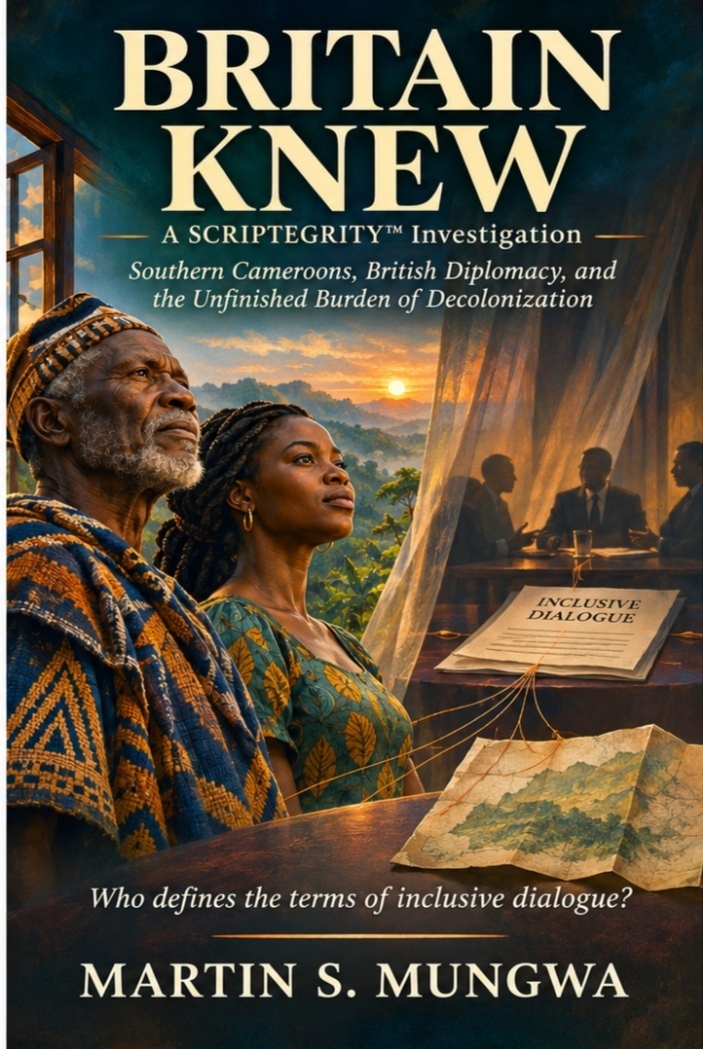
That is the provocation at the heart of Martin S. Mungwa’s Britain Knew. The book asks whether Britain’s retreat from Southern Cameroons in 1961 ended its responsibility—or merely allowed London to close the file while the political consequences gathered force. Its sharpest warning is for anyone preparing to accept another Canada-style process: if the parties do not agree on who is represented, what is being negotiated, and which outcomes are genuinely open, “dialogue” can become a monologue with diplomatic stationery.
The 1961 plebiscite offered two choices, each framed as achieving independence by joining another state. The ballot did not offer separate independence. After the vote, UN General Assembly Resolution 1608 called for urgent discussions among Britain, the Southern Cameroons government, and the Republic of Cameroun to finalize arrangements before 1 October. In Parliament, British minister Hugh Fraser described federation as the best solution and said the two sections would retain distinct identities.
Mungwa’s charge is that Britain helped usher Southern Cameroons toward “independence by joining,” then failed to ensure that the promised post-plebiscite arrangements could protect the smaller territory from absorption by a much larger, increasingly centralized state. The book does not claim that every later injustice was authored in London. Its indictment is more exacting: Britain knew the transition was perilous, heard warnings in Parliament, and still left before the constitutional and administrative settlement was secure.
Those warnings were not imaginary. On 1 August 1961, MP George Thomson described the union as approaching “singular obscurity and considerable peril,” questioned whether serious work had been done on the arrangements, and urged Britain to act before withdrawing. The minister acknowledged the complexity, while insisting the constitutional arrangements were for Cameroonians themselves. That exchange is the book’s uncomfortable exhibit: danger identified, responsibility discussed, departure still scheduled.
Mungwa also recalls Geoffrey Fisher, then Archbishop of Canterbury, asking in a 1961 debate on Central Africa: “What have we on our side done wrong?” Fisher was speaking about another British-controlled African crisis, not Southern Cameroons. But the question travels. It is precisely the question Britain must face when it calls for dialogue while publicly affirming Cameroon’s territorial integrity. A process that begins by declaring the map untouchable may invite participation while quietly excluding the central dispute.
The Canada episode makes that concern concrete. In January 2023, Canada announced a peace process involving the Cameroonian government and several separatist groups; Cameroon’s government then said it had not authorized a foreign mediator. That record does not prove that Britain designed a Canadian monologue. It does show how quickly a peace initiative can lose legitimacy when consent, mandate, and representation are contested.
The book’s most provocative thesis is that Britain’s influence could return through the architecture of diplomacy: not direct rule, but a process that preserves the existing state framework and asks Southern Cameroonians to negotiate only within it. That is an argument about political effect and motive, not proof of a secret British plan. Readers will rightly press Mungwa for still more primary evidence on who is shaping current initiatives and whose constitutional choices are excluded.
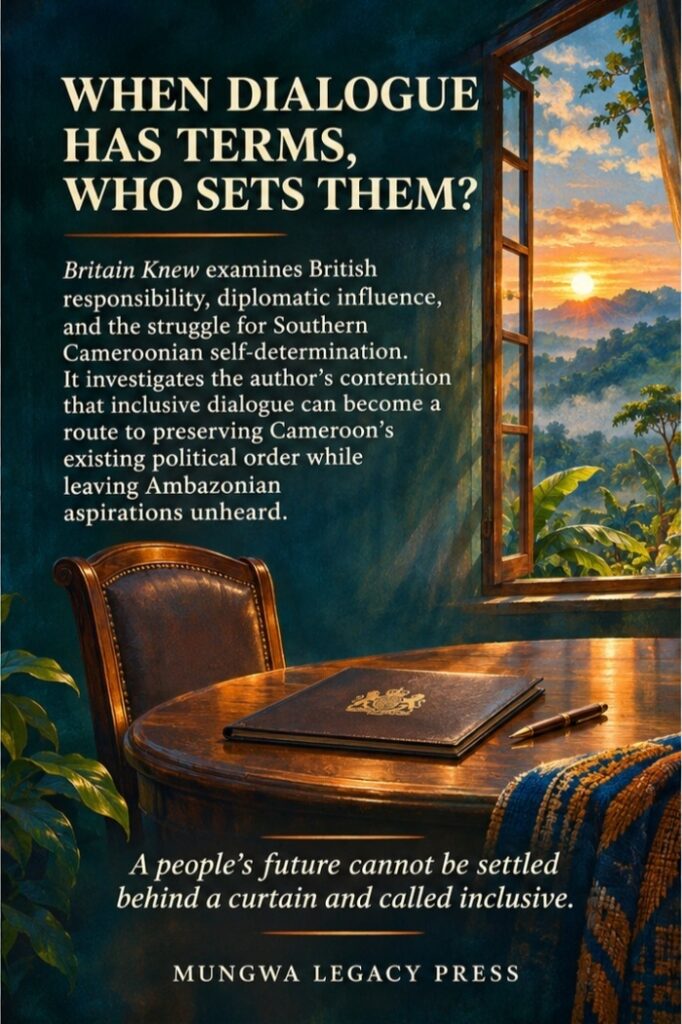
But the central challenge lands. If “inclusive dialogue” means accepting the status quo before talks begin, inclusivity is a label on a locked door. Britain Knew asks Southern Cameroonians to study the terms, scrutinize the sponsors, insist on representation chosen by the people concerned, and refuse a settlement whose conclusion is written before the first meeting.
Britain may say it has no appetite for control. The question Mungwa leaves ringing is simpler: who gets to set the terms—and who is expected to live with them?
The British are coming again, the book warns—not necessarily to govern, but to shape the conversation. Southern Cameroons should read the invitation before taking its seat.
As Amazon associate this site earns from qualifying purchases
Follow the Amazon link below to get your copies of other publications that touch on the Ambazonian revolution By Martin Mungwa
The Independentist News editorial desk




Leave feedback about this