












The question is not: Why should America rescue Ambazonia? The question is: Could peacefully resolving the Southern Cameroons conflict produce a democratic, productive and Atlantic-facing African partner that advances African stability while serving legitimate American interests? That question deserves a serious hearing. America does not have to choose Ambazonia’s future. But America should care enough to ensure that the future can be examined seriously, negotiated peacefully, tested against governing capacity, and ultimately decided with the people rather than decided for them.
By Martin S. Mungwa, PhD, MBA, P.E., F.ASCE
Contributor to The Independentist News
As Amazon associate this site earns from qualifying purchases
Shop from Amazon on back to school
On September 4, 2026, Dr. Michael Shurkin of Pax Americana submitted five deceptively simple questions concerning Southern Cameroons and the contemporary Ambazonian independence movement.
What is Ambazonia? Why do Ambazonians seek independence? How do they believe their objectives can be achieved? Why does the international community resist their claim? And why should Americans care?
These are not merely five questions about an African conflict. Properly considered, they form a chain of inquiry stretching from colonial history to constitutional legitimacy, from armed conflict to governing capacity, and from African borders to American strategic interests. They deserve answers without slogans, exaggeration or romanticism.
- WHAT IS AMBAZONIA?
To understand Ambazonia, one must begin with two Cameroons—not one. The territory once known as German Kamerun was divided after Germany’s defeat in the First World War. France administered the larger eastern territory, while Britain administered western territories alongside Nigeria under the League of Nations mandate system and later the United Nations trusteeship system. Those territories developed under different institutional traditions.
French Cameroun evolved through French administrative, legal and educational systems. British Southern Cameroons developed largely within British parliamentary practice, the Common Law tradition and English-language education. By the late trusteeship period, Southern Cameroons was not simply a collection of English-speaking communities. It possessed political institutions: a House of Assembly, a government, a Premier, an opposition, courts, political parties and its own public administration.
French Cameroun became independent on January 1, 1960, as the Republic of Cameroun. Southern Cameroons remained a United Nations Trust Territory. In the United Nations-supervised plebiscite of February 1961, Southern Cameroonians were asked to achieve independence either by joining Nigeria or by joining the already independent Republic of Cameroun. Separate sovereign independence was not one of the choices placed before them.
Southern Cameroons voted to join the Republic of Cameroun, and a federal arrangement subsequently emerged in which the former Southern Cameroons became West Cameroon. The federation was abolished in 1972. Political authority became progressively more centralized. In 1984, the country’s name was changed from the United Republic of Cameroon back to the Republic of Cameroon.
The legal consequences of that history remain contested, and they should not be presented otherwise. But the historical sequence is indispensable to understanding today’s dispute. No Southern Cameroons is the historical territory. Ambazonia is the contemporary nationalist designation and political aspiration adopted by many seeking restoration of sovereign self-government for that territory. Erase that distinction, and the conflict is misunderstood before serious analysis even begins.
- WHY DO AMBAZONIANS SEEK INDEPENDENCE?
The independence movement did not arise simply because people speak English. Language is important, but underneath language lies a deeper constitutional argument. For many Southern Cameroonians, the central grievance is that the political relationship entered into in 1961 was understood as one that would preserve meaningful self-government, institutional identity, Common Law traditions, English-language education and a distinct political space within a federation. The federation disappeared. Centralization increased. Over time, many Southern Cameroonians concluded that what they believed had begun as a constitutional relationship between two political entities had become absorption into a centralized state.
The crisis that erupted in 2016 exposed how deep that mistrust had become. Lawyers protested measures they believed threatened the Common Law legal tradition. Teachers protested developments affecting the English-language educational system. The confrontation widened. Arrests, repression, violence, school disruption, displacement and ultimately armed conflict followed.
That transformation changed the political psychology of the territory. People who once demanded reform, decentralization or a return to meaningful federalism increasingly concluded that the centralized state could no longer be trusted to protect the institutions and identity they believed the 1961 relationship was intended to preserve. Credibility, however, requires acknowledging another uncomfortable truth.
Civilian abuses have been attributed both to state forces and to separatist armed groups. No movement earns moral authority by excusing abuses committed in its own name. A civilian harmed by violence does not suffer less because the perpetrator claimed the correct political cause. That is why the Southern Cameroons conflict should not be reduced to the phrase “Anglophone crisis.” Language is visible. Beneath it lies the harder question of consent, constitutional identity and the nature of the political union created in 1961.
- HOW CAN THE INDEPENDENCE MOVEMENT ACHIEVE ITS OBJECTIVES?
Here the movement confronts perhaps its greatest internal challenge. Winning attention is not the same thing as building a state. There is no single Ambazonian organization exercising uncontested authority over the independence movement. There are political organizations, diaspora bodies, self-described governments-in-exile and transitional authorities, civil-society actors, local organizations, armed groups and individual leaders. They frequently disagree about leadership, tactics, negotiation, legitimacy and timing. That fragmentation cannot be wished away.
A viable strategy therefore has to move beyond agitation toward statecraft. The first requirement is a historical and constitutional case capable of surviving skeptical examination. Not slogans. Documents. Evidence. Law. History. Institutional memory. Second, there must be credible international engagement around a political process capable of addressing the actual dispute.
Parties should be able to enter talks through an acceptable mediator or facilitator without being forced to surrender their principal political positions before negotiations even begin. The principle should be straightforward: Dialogue without preconditions—but not dialogue without principles.
Third, civilian protection must become non-negotiable. If a movement aspires to govern civilians tomorrow, it cannot treat civilian welfare as expendable today. Schools, hospitals, farms, markets, utilities, roads, telecommunications and other productive assets are not simply objects in a political contest. They are the foundations upon which any future society must stand.
Fourth comes perhaps the most difficult test: governing capacity. Liberation capacity is not governing capacity. Aspiration is not completed capacity. Mobilizing supporters is one capability. Operating courts, hospitals, electricity systems, customs services, public finances, police institutions, ports, schools, records systems and credible elections under law is another.
A serious independence project should therefore be capable of passing at least five tests: constitutional legitimacy, administrative effectiveness, civilian protection, productive capacity and external relations. The appropriate pathway to recognition should consequently be understood as a sequence: Historical Case → Peace Credibility → Institutional Readiness → Territorial and Administrative Capability → Economic Viability → External Reliability → Recognition Decision.
International recognition is enormously important. But recognition cannot operate an electricity grid. Recognition cannot balance a treasury. Recognition cannot manufacture a professional civil service. And recognition cannot substitute for legitimacy. The strongest Ambazonian argument should therefore not be: “Recognize us because we have suffered.” It should rather be: “Examine our historical case. Help create a credible path to peace. Test our governing readiness. Examine our economic viability and external reliability. Then judge whether we can become a responsible state.” That is the movement from advocacy to statecraft.
- WHAT ABOUT PANDORA’S BOX?
This is the international community’s hardest objection, and it deserves a serious answer. Africa inherited extraordinarily complicated borders. Many were created by colonial powers with limited regard for preexisting political, cultural and economic realities.
At independence, African leaders confronted an enormous danger. If every inherited boundary were immediately reopened, the continent could descend into continuous territorial revision and war. That concern helped produce the strong African commitment to territorial integrity and inherited borders. It remains a legitimate concern today.
If every dissatisfied province, linguistic community or ethnic group automatically acquired a right to independent statehood, African fragmentation could become endless. But that does not eliminate the need to distinguish one historical case from another. The Southern Cameroons argument is not simply: “We are an unhappy linguistic minority, therefore redraw Cameroon’s borders.”
The argument is that British Southern Cameroons itself existed as a separately administered League of Nations mandate and United Nations Trust Territory, with identifiable territory, institutions, government and political personality before the 1961 constitutional relationship. That produces a more difficult question: Would Southern Cameroons independence destroy an inherited colonial boundary? Or would it restore sovereign political meaning to a territorial unit and boundary that already existed before the 1961 union?
That question deserves examination rather than dismissal. International law has not conclusively settled the matter in Ambazonia’s favor. Competing interpretations remain regarding self-determination, territorial integrity, constitutional continuity, recognition and the consequences of the 1961 arrangements. And outsiders are entitled to ask difficult practical questions. Who legitimately speaks for Southern Cameroons? Can the territory be governed? How would minorities be protected? What rights would belong to citizens who oppose independence? What becomes of armed organizations? What security arrangements would exist along the Nigerian frontier? Can the economy sustain the obligations of a state? Would recognition create lasting peace—or simply relocate the conflict? Those questions are not insults. They are tests of seriousness. The answer to the Pandora’s-box objection should therefore not be to ignore the box. Examine this particular box carefully.
Stable borders matter. But history matters. Consent matters. Constitutional integrity matters. Civilian protection matters. And political systems must retain the capacity to resolve legitimate disputes without turning inherited borders into prisons from which peaceful constitutional remedies are impossible. The governing principle should not be that borders can never change. The principle should be that borders must never change casually.
- WHY SHOULD AMERICANS CARE?
America should care about Southern Cameroons not because the United States needs another distant conflict to own, but because unresolved conflicts in strategically important places can eventually become far more expensive than serious diplomacy.
The first reason is humanitarian. People have been killed. Communities have been displaced. Schools have been disrupted. Livelihoods have been destroyed. Civilians have suffered from abuses attributed to both government forces and armed separatist groups. Human life is reason enough to care.
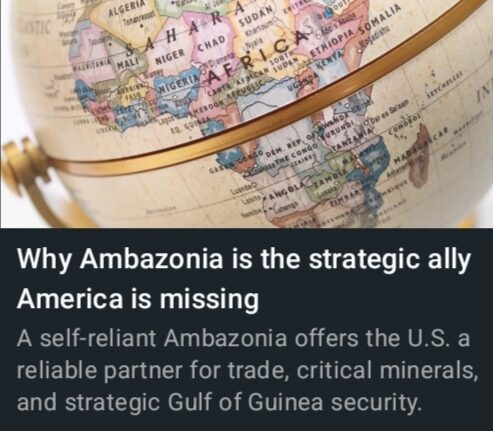
But there is also a strategic case. The Gulf of Guinea Southern Cameroons lies on the Gulf of Guinea. That immediately connects the conflict to maritime commerce, ports, fisheries, energy, Atlantic trade, trafficking and regional security. Instability along strategically important Atlantic corridors rarely remains an entirely local matter. Nigeria Then look west. Southern Cameroons borders Nigeria, one of Africa’s largest and most consequential states. Trade, refugee movements, migration, security, family networks and commerce cross that frontier. A prolonged armed conflict beside Nigeria cannot reasonably be viewed forever as an isolated provincial disagreement.
Security The deterioration of security across the Sahel has demonstrated how rapidly weak institutions, armed movements, illicit finance, organized crime and political collapse can reinforce one another. The United States has a legitimate interest in preventing such patterns of instability from becoming entrenched farther south toward the Gulf of Guinea.
Supply Chains and Productive Sovereignty. Washington is increasingly attentive to supply-chain resilience, strategic resources, technology, infrastructure and dependable commercial partners. But Southern Cameroons must approach this subject with discipline. No serious movement should walk into Washington promising mineral riches that have not been independently verified.
The proper rule is: Geology before geopolitics. If commercially viable resources exist, prove them. Then ask the harder economic questions. Who owns the productive asset? Who signs the contract? Who provides the technology? Who processes the resource? Who captures the margin? Where are taxes paid? What environmental protections apply? What skills remain locally? And most importantly, after the transaction is completed, what productive capability remains behind?
That is the difference between resource extraction and productive sovereignty. A Different Kind of African Partnership The final question for Americans is larger. Could a peaceful Southern Cameroons eventually become the kind of African partner the United States repeatedly says it wants? Democratic. Commercially open. Institutionally credible. Atlantic-facing. Strategically autonomous. Friendly toward the United States without becoming permanently dependent upon it. That possibility does not require America to launch a military intervention. It does not require a blank check. It does not require Washington to dictate the final political outcome. It requires something far more realistic:
Give the Southern Cameroons question a serious strategic hearing. Examine the history. Study the constitutional dispute. Protect civilians. Support credible facilitation. Consider Nigeria. Consider the Gulf of Guinea. Examine governing capacity. Examine economic viability. And determine whether peaceful resolution could ultimately produce a stable, democratic and productive Atlantic-facing African partner.
FROM GRIEVANCE TO GOVERNING CAPACITY
These five questions ultimately collapse into one. Can an unresolved historical grievance be converted into credible governing capacity? That is the test confronting Ambazonia. History can explain why a movement exists. Suffering can explain why people demand change. Mobilization can demonstrate commitment. But none of those, standing alone, creates a state. A serious national project must demonstrate that it can protect civilians, preserve productive assets, administer institutions, generate economic opportunity, tolerate political disagreement, engage the world responsibly and place law above faction.
The international community, for its part, should resist two equally dangerous temptations. The first is assuming that every separatist claim deserves recognition. The second is assuming that no inherited political arrangement can ever be reconsidered regardless of history, consent, institutional collapse or prolonged conflict. Neither position is adequate. Southern Cameroons deserves something more demanding than automatic endorsement and more serious than automatic dismissal. It deserves examination. And America should understand what is being asked.
The question is not: Why should America rescue Ambazonia? The question is: Could peacefully resolving the Southern Cameroons conflict produce a democratic, productive and Atlantic-facing African partner that advances African stability while serving legitimate American interests? That question deserves a serious hearing. America does not have to choose Ambazonia’s future. But America should care enough to ensure that the future can be examined seriously, negotiated peacefully, tested against governing capacity, and ultimately decided with the people rather than decided for them.
As Amazon associate this site earns from qualifying purchases
Shop from Amazon on back to school
https://www.amazon.com/s?k=back+to+school+needs&rh=p_6%3AA2N0PBIRR6F78F&dc=&ds=v1%3A1nbdSoXGtNwH6%2F4WC3U9ftjZoWRiEZVr3ED%2BlK%2BzQnc&qid=1788373179&rnid=331539011&linkCode=ll2&tag=njokings-20&linkId=eacf29c976e56014ca7c68589f20543b&language=en_US&ref_=as_li_ss_tl
Martin S. Mungwa, PhD, MBA, P.E., F.ASCE
Contributor to The Independentist News




Leave feedback about this