










News commentary

We are home to news on Cameroon and the CEMAC region. We are dedicated to honest and reliable reporting. We are the voice of the Cameroonian people and their fight for freedom and democracy at a time when the Yaoundé government is silencing dissent and suppressing democratic voices.

Peter Obi must stand firm. The legal traps must be confronted. The political coalition must be protected. The people must not be abandoned. The future of Nigeria, and perhaps the moral direction of a New Africa, may depend on whether this moment is met with courage, discipline, and strategic resolve.
By Timothy Enongene
Associate Editor-in-Chief, Independentist News
Lokoja – July 15, 2026 – The recent legal maneuvers in Nigeria, especially the controversial Federal High Court ruling in Lokoja affecting the status of the Nigeria Democratic Congress, should trouble every African who still believes that democracy must mean more than elections staged under elite control. According to recent reports, the court set aside an earlier judgment that had directed the Independent National Electoral Commission to register the NDC as a political party, thereby placing the party’s legal status and political future under serious pressure. The NDC has reportedly appealed and taken steps to preserve its position before INEC, including the submission of Peter Obi’s name on the electoral portal.
For those watching from outside Nigeria, this development is not merely a Nigerian legal matter. Across West Africa, ruling establishments have too often learned how to use courts, electoral commissions, security agencies, technical rules, and administrative procedures to weaken popular movements before citizens are allowed to decide freely at the ballot box. The danger is clear: when law becomes a weapon of exclusion rather than a shield of justice, democracy begins to lose its moral foundation.
From an Ambazonian perspective, we understand what it means to face systems designed to silence a people’s demand for justice, dignity, self-determination, and accountable governance. We understand the pain of legal structures that appear orderly on paper while denying people meaningful political voice in practice. It is from this vantage point of shared struggle against systemic marginalization that we look across the border to Nigeria and say: Peter Obi must not retreat.
A Leadership That Transcends Borders
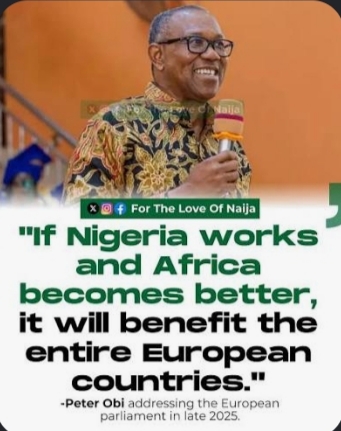
Peter Obi’s political journey is no longer only a Nigerian story. It has become a continental symbol of disciplined leadership, public accountability, and generational impatience with political decay. For too long, Africa has been held back by entrenched elites more interested in personal survival, patronage networks, and regional control than in genuine national transformation. Obi represents a different possibility: competence, restraint, administrative seriousness, fiscal discipline, and a language of governance that speaks to young Africans tired of empty promises.
When Africa’s most populous nation stumbles under bad governance, the whole continent feels the consequences. Nigeria’s failures are never contained within Nigeria alone. They affect the Gulf of Guinea, West Africa, migration flows, trade, regional security, democratic confidence, and Africa’s global standing. Conversely, a stable, productive, democratic, and well-governed Nigeria could become one of the great anchors of African renewal.
That is why Obi matters beyond party politics. He is not merely pursuing office. He represents the hope that African politics can still produce leaders who respect public resources, value competence, and understand that government is not a private estate. Millions of young Nigerians and Africans see in him a possibility that has been denied for too long: that leadership can be serious, ethical, modern, and accountable.
The Coalition Behind the Mandate
The forces seeking to frustrate the NDC or weaken Obi’s 2027 presidential path appear driven by fear of a broad political coalition that cannot easily be defeated through ordinary democratic competition. Obi’s appeal cuts across regions, religious lines, ethnic categories, class divisions, and even national borders. His message resonates with citizens who want jobs, security, infrastructure, economic discipline, justice, and a government that does not insult their intelligence.
Across Africa and within the diaspora, many see Obi as one of the clearest standard-bearers of a New Africa. His reported alliance with Rabiu Musa Kwankwaso, if sustained with discipline and strategic clarity, could represent a powerful cross-regional understanding in Nigerian politics. Such a coalition would be difficult for the old order to dismiss as a sectional uprising or youthful noise. It would suggest a national consensus against failure.
That is precisely why technical obstacles, judicial uncertainty, administrative pressure, and political intimidation must be watched carefully. When powerful establishments fear defeat, they often shift the struggle away from the people and into procedural traps. They move from ballots to courtrooms, from debate to disqualification, from persuasion to exclusion. This is how democracies are hollowed out while still pretending to be constitutional systems.
Leave No Stone Unturned
To Peter Obi, the message is clear: do not retreat. The legal response by the NDC, including the reported appeal and efforts to preserve access to the INEC process, is an important first step. But legal action alone is not enough. The struggle must be constitutional, peaceful, disciplined, strategic, and broad. Every lawful political, diplomatic, civic, and grassroots avenue must be used to defend democratic choice. The courts must be engaged, but the people must also remain informed. Institutions must be challenged, but violence must be avoided. International observers, civil society, religious leaders, youth movements, professional associations, and the diaspora must pay close attention.
Obi must capitalize on his immense goodwill without allowing anger to become disorder. His strength has always been moral seriousness, discipline, and credibility. That must remain his advantage. He should insist on due process, electoral fairness, personal safety, and the right of Nigerians to choose freely among credible alternatives.
Africa is watching because Nigeria is too important to fail quietly. The youth of Nigeria, the oppressed peoples of the region, and millions across the diaspora understand what is at stake. This is not simply about one party or one man. It is about whether African democracy will remain a managed ritual controlled by entrenched interests, or whether citizens will finally be allowed to convert hope into power.
Peter Obi must stand firm. The legal traps must be confronted. The political coalition must be protected. The people must not be abandoned. The future of Nigeria, and perhaps the moral direction of a New Africa, may depend on whether this moment is met with courage, discipline, and strategic resolve.
Timothy Enongene
Associate Editor-in-Chief, Independentist News
Share This Post:
A PEOPLE ARE NOT A LANGUAGE: Why Abandoning “Anglophone” Is Essential to Freedom, Justice, and Peace in the Southern Cameroons
The Empire That Lost the Map: Why Britain’s Former Colonies Now Outweigh the Crown in Power, Territory, and Destiny
Related Post
A PATRIOT, Pa Che Alias (AMBA WARRIOR), PUTS DABNEY
PROPHECY, POLITICS, AND THE AMBAZONIAN QUESTION (PART V) —
ARCHBISHOP NKEA AND THE LRC MIND GAME: WHO SAYS
PROPHECY, POLITICS, AND THE AMBAZONIAN QUESTION (PART IV) BUSINESS
Dr. Martin Mungwa shares the mile stone of the
DION NGUTE’S DIALOGUE NARRATIVE: AMBAZONIA AND LRC ARE NOT