









Commentary

We are home to news on Cameroon and the CEMAC region. We are dedicated to honest and reliable reporting. We are the voice of the Cameroonian people and their fight for freedom and democracy at a time when the Yaoundé government is silencing dissent and suppressing democratic voices.

The old British Empire believed ships, trade, finance, colonies, ceremony, language, and monarchy could sustain greatness forever. But when the colonies left and the imperial map disappeared, Britain was forced to live on memory. America built power into a continent. China and Russia continue to display scale as strength. India, once ruled, now rises with demographic and economic weight that Britain can no longer command.
By Ali Dan Ismael Editor-in-chief The Independentist News
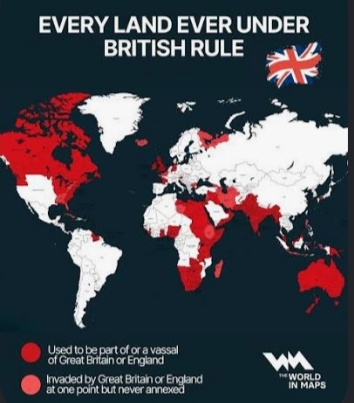
The British Empire once ruled the map.
It painted continents, islands, ports, rivers, trade routes, colonies, protectorates, and peoples in imperial color and called it destiny. It built a global system of naval power, merchant shipping, financial control, colonial administration, intelligence networks, royal symbolism, and diplomatic language. For a time, Britain could look at the world and see not merely countries, but possessions, routes, stations, markets, and subjects. The empire was not only a political system. It was a map.
That map gave Britain status. It gave Britain scale. It gave Britain access. It gave Britain minerals, labor, ports, crops, shipping lanes, soldiers, markets, and prestige. Britain did not become powerful by ceremony alone. It became powerful by controlling geography. The Crown sat in London, but the empire’s body stretched across the world. Today, that body is gone. The Crown remains. The map does not.
That is the central tragedy of British imperial decline. Britain still has monarchy, memory, ceremony, universities, financial services, intelligence networks, diplomatic habits, and polished language. But it no longer possesses the territorial scale that once made those symbols command attention. The empire has been reduced from world map to historical brand.
The former colonies have moved on. Some have become giants. Some have become strategic powers. Some have become demographic engines. Some now carry the future Britain once imagined for itself. The empire lost the map, and the world changed.
The Geography of Imperial Lifespan
Land matters. In every age, great powers pretend that their strength comes only from ideas, values, institutions, technology, finance, or military genius. These things matter, but beneath them all lies geography. Power requires territory. Armies need depth. Industries need land. Food requires farms. Energy requires space. Ports require coastlines. Minerals require soil. Populations require settlement. Empires require maps.
Landmass extends the lifespan of power because it gives a state room to absorb shocks. A large country can retreat, reorganize, disperse industry, protect food production, relocate populations, and survive pressure. It can contain multiple climates, resource zones, cities, ports, agricultural belts, military regions, and internal markets. If governed well, land becomes time. It allows a nation to survive crises longer than rivals expect. This is why continental powers endure differently from maritime empires.
Britain’s empire was vast, but it was not built as a single continental organism. It was maritime, commercial, and overseas. It depended on naval supremacy, merchant fleets, colonial routes, ports, bases, financial networks, and administrative control over distant peoples. For a time, this system worked brilliantly. Britain controlled the sea lanes and profited from empire. But overseas empire contains a hidden weakness. The land does not belong permanently to the imperial center. The people eventually rise. The colonies eventually leave. The map eventually changes.
When that happened, Britain could no longer point to the world and say: this is ours. Once the empire dissolved, Britain was left with an island, a Crown, a flag, a language, and memory. It could still speak as if history obeyed it, but the map no longer did. That is why the loss of empire was not only political. It was spatial. Britain lost strategic depth. It lost demographic reach. It lost imperial real estate. It lost the physical scale that had once impressed rivals and intimidated subjects. The empire survived as nostalgia. The territory did not.
America Learned the Lesson of Land
The United States understood what Britain failed to secure permanently. America became powerful not merely because of democracy or capitalism, but because it converted continental expansion into a durable national platform. It acquired and integrated land across a continent. It built a republic that became an empire-sized state. Its power rested on farmland, rivers, railroads, highways, minerals, oil, gas, ports, cities, universities, immigrants, military depth, and two oceans. America did not merely trade across the world. It occupied a continental base from which to project power.
That is why America could outgrow many older empires. It had space. It had food. It had energy. It had internal markets. It had a vast industrial platform. It had room to absorb immigrants and convert them into labor, innovation, military service, entrepreneurship, and demographic renewal. It had enough land to make national ambition physically believable.
Even today, despite America’s continental size, its strategic imagination still reaches outward. Recent American rhetoric about Greenland and Canada should not be dismissed merely as political theater. Greenland sits at the center of Arctic strategy, near emerging shipping routes, rare earth resources, missile-warning systems, and the military frontiers of Russia, China, Europe, and North America. Canada is not empty space either. It is land, water, energy, minerals, Arctic access, agriculture, forests, ports, demographic room, and continental depth. Even when such language is unrealistic as policy, it exposes the old truth: great powers never stop thinking about territory.
Technology has not abolished geography. Finance has not abolished land. Artificial intelligence has not abolished ports. Satellites have not abolished minerals. Digital currencies have not abolished food. Space power has not abolished coastlines, rivers, bases, and strategic depth. A state may dominate cyberspace, but it still needs physical ground beneath its power.
China, Russia, and the Theater of Size
China and Russia understand this clearly. Russia’s size is part of its identity. Its vastness gives it strategic depth, resource abundance, military imagination, and imperial psychology. Even when Russia faces economic weakness, sanctions, demographic problems, or military setbacks, its landmass still projects scale. A large map can become a weapon of perception. It tells rivals that this state cannot be easily surrounded, occupied, starved, or erased.
China’s power also rests partly on scale. Its landmass, population, industrial regions, river systems, ports, manufacturing capacity, internal market, and strategic corridors give it the foundation for long-term competition. China’s ambitions in the South China Sea, Taiwan, Central Asia, Africa, Latin America, and global infrastructure networks are not random. They reflect a state that understands that geography, supply chains, ports, minerals, and corridors define the future of power.
Both China and Russia know that empire is not only an army. Empire is space. Empire is access. Empire is minerals. Empire is population. Empire is food. Empire is ports. Empire is industrial depth. Empire is the ability to survive pressure longer than rivals expect. This is why great powers behave as if land still matters. Because land does still matter.
Britain’s Maritime Illusion
Britain believed too much in ships. It believed in merchant fleets, naval supremacy, maritime insurance, banking, trade routes, colonial ports, and the ability to turn oceans into corridors of command. That belief was not foolish in its time. It made Britain rich. It made Britain feared. It allowed Britain to project power far beyond its island size. But Britain confused control of routes with permanent control of destiny. Ships move. Ports change hands. Colonies become nations. Trade routes can be contested. Merchant fleets decline. Naval supremacy is expensive. Finance can relocate. Industrial leadership can be lost.
A maritime empire can dominate the world for a season, but if it does not convert imperial reach into durable territorial depth, it becomes vulnerable when the tide turns. Britain did not lack brilliance. It lacked permanence. It built an empire across other people’s land, but it could not keep that land once those people reclaimed themselves. When the empire was lost, Britain could not prove ownership of enough strategic real estate to impress the rivals it once overshadowed. It could still host ceremonies. It could still send envoys. It could still deploy wit. It could still use the double meaning of words. But the map had shrunk.
The old empire became a master of language because it had lost much of the geography that once gave language force. When the Colonies Outgrew the Crown The deepest humiliation of imperial decline is not military defeat alone. It is the moment when former colonies outgrow the imperial center.
Today, the United States is not merely larger than Britain. It is overwhelmingly more powerful in economic, military, technological, demographic, and strategic terms. India, once described through the arrogance of empire as the “jewel in the crown,” has emerged as one of the world’s largest economies and a central actor in the twenty-first-century balance of power. This is the great reversal. The colony became the superpower. The jewel became a giant. The Crown became a symbol.
Britain once ruled over peoples it presumed to instruct, civilize, administer, and command. Today, those same former colonies sit across the table as powers in their own right. America no longer needs British approval. India no longer needs British validation. The empire that once claimed to organize the world now watches former subjects shape global markets, technology, diplomacy, defense, demographics, and development. That is why British prestige increasingly depends on ceremony. The monarch visits. The flags are raised.The bands play. The speeches are delivered. The applause comes.The language is polished. The phrases are carefully constructed.
British diplomacy still knows how to use words with double meanings, historical echoes, and carefully layered politeness. But applause is not obedience. Diplomatic courtesy is not submission. A standing ovation is not imperial restoration.
When a British monarch or senior British figure visits the United States, the applause should be understood for what it is: diplomatic respect within a relationship now dominated by American power. Yet British nostalgia can easily misread courtesy as awe. It can mistake polite reception for proof that the old imperial language still commands the room. It can imagine that Americans fail to understand British verbal subtlety, when in fact Americans may simply be practicing courtesy toward an old ally whose global position has diminished. That is how low the empire has fallen.
Its pride now often rests not on territory, not on industrial supremacy, not on demographic strength, not on global command, but on the belief that it still possesses superior language, superior manners, superior irony, and superior diplomatic nuance. But words cannot replace power forever. A clever phrase cannot rebuild an empire. A royal visit cannot restore lost colonies. A polished accent cannot conceal economic decline. A ceremony cannot substitute for strategic mass.
The United States and India prove that history has moved. The old imperial center no longer sits above its former colonies. In some cases, it now looks upward at them. Britain may still have institutions, universities, intelligence networks, financial services, and diplomatic memory. But memory is not command. Prestige is not power. Ceremony is not sovereignty over others. The world has changed. The former colonies are no longer waiting outside the imperial door. They have built larger houses.
The Spitfire and the Betrayal of Southern Cameroons
There is another irony that should not be forgotten. During the Second World War, even small colonial territories were drawn into Britain’s imperial war effort. The Spitfire Fund became one of the symbolic instruments through which civilians, communities, colonies, and overseas territories were encouraged to contribute to Britain’s defense. The cost of a Spitfire was treated symbolically, and communities that raised money could have aircraft associated with their names. Records of wartime Cameroons Spitfire Fund stamps, covers, and fundraising material show that Cameroons was drawn into this imperial effort. Think about the meaning of that.
A small, colonized territory—politically insignificant in the eyes of empire—was asked to help defend Britain in its hour of danger. Its people were expected to contribute loyalty, money, labor, and moral support to an imperial war whose decisions were made far away. The empire could remember Southern Cameroons when it needed sacrifice. It could remember colonial subjects when it needed war support. It could summon loyalty from people who did not control their own destiny.
But when Southern Cameroons later needed Britain to defend justice, identity, constitutional protection, and political dignity, Britain’s memory weakened. The people who had been useful to empire in wartime were later treated as expendable in diplomacy. The same imperial system that could mobilize colonial loyalty failed to secure Southern Cameroons from political absorption into La République du Cameroun.
The same Britain that could draw support from small territories in the name of freedom did not show equal courage when those territories needed freedom protected. That is the bitterness of the Spitfire story. Southern Cameroons could be called upon to help defend Britain from tyranny in Europe, yet its own future was later handed into a political arrangement that trapped it under the domination of another state. Britain accepted colonial loyalty when it was convenient, but did not repay that loyalty with constitutional justice.
The Spitfire rose in the sky. Southern Cameroons was left on the ground. That is how empire works. It remembers the small when it needs sacrifice and forgets them when sacrifice should be repaid with justice. It asks the colonized to defend liberty abroad, then denies them meaningful liberty at home. It receives loyalty, then returns abandonment.
Commonwealth Remembrance and the Tomb of Forgotten Loyalty
Today, during Commonwealth remembrance ceremonies, Britain stands before monuments, lays wreaths, speaks of sacrifice, honors the dead, and invokes the language of duty, freedom, service, and shared history. The empire remembers war when remembrance strengthens Britain’s moral image. It remembers colonial soldiers when their sacrifice adds dignity to British ceremony. It remembers loyalty when loyalty can be folded into the pageantry of the Commonwealth. But where is Southern Cameroons in that remembrance?
More than seventy years later, the people of Southern Cameroons are not remembered as a people whose loyalty deserved justice. Those who contributed to Britain’s imperial war effort, those who gave labor, money, service, and belief to an empire that claimed to defend freedom, have been buried in the tomb where strategic interests go to die. Their sacrifice is remembered only when useful, forgotten when justice is demanded. That is the cruelty of empire. It can remember the dead without honoring the living. It can praise sacrifice without correcting betrayal. It can lay wreaths while ignoring the political grave into which it helped place a people.
In return for loyalty, Southern Cameroons received abandonment. In return for sacrifice, it received diplomatic silence. In return for trust, it was left exposed to domination by La République du Cameroun. Britain accepted everything when it needed support, then returned almost nothing when Southern Cameroons needed protection. And now, what remains?
British diplomats visit villages, smile from ear to ear, speak Lamso, speak Pidgin English, wear local dress, and offer gestures of cultural familiarity. The performance is presented as warmth, friendship, and respect. But to a people who gave loyalty and received abandonment, such gestures can feel like mockery. A smile is not justice. A greeting in the local language is not restitution. A small grant is not historical repair. Cultural performance cannot substitute for political responsibility. That is the definition of empire. Empire learns your language when it wants your trust. Empire praises your culture when it wants applause. Empire honors your sacrifice when it needs ceremony. Empire forgets your rights when justice becomes inconvenient.
Southern Cameroons did not need Britain to speak Pidgin with affection after the damage was done. It needed Britain to defend the political dignity of a people whose future was placed in its hands. It needed constitutional protection. It needed honest diplomacy. It needed courage. It needed Britain to remember that loyalty creates moral obligation. Instead, Britain gave smiles. It gave ceremonies. It gave diplomatic language. It gave the Commonwealth. But it did not give justice.
That is why the Spitfire story must be remembered. It is not merely about an aircraft. It is about the moral debt Britain owes to a people it summoned in wartime and abandoned in peacetime. It is about the difference between remembrance and responsibility. It is about a small people whose loyalty rose into the sky while their political future was buried on the ground. The Spitfire flew. The wreaths are laid. The diplomats smile. But Southern Cameroons still waits for justice.
The Crown That Did Not Answer
The betrayal did not end with silence from British governments. It reached the Crown itself. The plea for Ambazonian independence was placed directly before the late Queen Elizabeth II. According to Ambazonian advocates, the matter was formally brought before the very institution that symbolizes British continuity, duty, honor, and constitutional memory. Yet to her dying day, the Queen never gave Southern Cameroons the answer it deserved. That silence speaks.
The Crown knew the history. It knew Britain’s role. It knew that Southern Cameroons had been administered under British authority. It knew that a people entrusted to British care had been left exposed to political absorption by La République du Cameroun. It knew that the Commonwealth language of justice, partnership, and shared values could not erase the unresolved moral wound. Yet the Crown did not speak. That is the deeper lesson for Ambazonia.
If even the monarchy could not keep faith with a people whose future passed through British hands, what should Ambazonians expect from ordinary British governments driven by elections, interests, trade, diplomacy, and convenience? If the Crown, with all its rituals of honor, duty, memory, and service, could remain silent, what moral rescue should anyone expect from Westminster? Ambazonia must open its eyes. A people cannot build its future on royal sympathy. A people cannot wait forever for imperial conscience. A people cannot place its destiny in the hands of those who already failed to protect it. Britain’s silence is not confusion. It is policy. The monarchy’s silence is not accident. It is inheritance. The Commonwealth’s silence is not forgetfulness. It is convenience.
Southern Cameroons gave loyalty to Britain when Britain needed it. It trusted Britain when Britain held responsibility. It appealed to Britain when justice was required. But Britain answered with ceremonies, smiles, local-language diplomacy, and silence.
That is why Ambazonia must stop mistaking British politeness for British protection. The smile is not justice. The accent is not justice. The royal silence is not neutrality. The Commonwealth is not salvation. The British state has shown what it is prepared to remember and what it is prepared to bury. It remembers sacrifice when it decorates British history. It forgets responsibility when responsibility threatens British interests. That is the definition of empire. Ambazonia must open its eyes.
The Double Meaning of Decline
British power has always depended partly on language. The empire loved coded phrases, polite insults, diplomatic ambiguity, legal wording, royal symbolism, and constitutional subtlety. It could say one thing and mean another. It could flatter and diminish in the same sentence. It could cloak domination in civility and call exploitation partnership. That language once worked because it rested on power. The words mattered because the empire had ships, troops, colonies, banks, and administrators behind them. Today, the words remain, but the power behind them is thinner.
That is why British elites sometimes cling to verbal cleverness as evidence of superiority. A phrase with double meaning becomes a small imperial trophy. A speech becomes a performance of inherited refinement. A royal visit becomes an opportunity to demonstrate tradition. A carefully chosen word becomes proof, in the British imagination, that others lack the fine ear to understand the old code. But the world is no longer ruled by those codes. America may applaud politely and still dominate the relationship. India may host respectfully and still know its own weight. Africa may listen diplomatically and still remember betrayal. The Commonwealth may smile and still understand hierarchy. The applause is not ignorance. The handshake is not submission. The courtesy is not consent. The world has learned the language of empire and is no longer mesmerized by it.
The Real Estate of Prestige
Territory carries psychological power. A large state impresses. A large map intimidates. A large frontier suggests destiny. A small island that once ruled a large empire may still possess history, but history cannot substitute indefinitely for territory. Rivals respect capability, not memory. They respect control, not ceremony. They respect resources, not nostalgia.
Britain’s problem is that much of its modern prestige is inherited from a world it no longer controls. It still has diplomatic language, intelligence networks, royal symbolism, elite universities, financial services, and historical reputation. But it no longer has the imperial real estate that once made those symbols frightening.
America has real estate. Russia has real estate. China has real estate. India has demographic and continental scale. Even when these powers face internal problems, their maps speak before their diplomats do. This is why landmass remains a form of geopolitical theater. It is not enough by itself. A large failed state can still be weak. A poorly governed large country can waste its advantages. But when landmass is combined with institutions, population, military power, technology, capital, agriculture, and strategic leadership, it becomes one of the foundations of enduring power. A country with land and strategy can outlast a country with slogans and memory.
What Small Nations Must Learn
This lesson matters for Africa and for Ambazonia. A small nation cannot afford to misunderstand territory. Land is not just soil. Land is food security, mineral wealth, settlement space, ecological protection, hydropower, corridors, ports, cities, tourism, agriculture, industry, identity, and defense. A people that treats land casually will eventually lose control of its future.
Ambazonia must understand that its territory is not small in meaning. It contains coastline, highlands, forests, rivers, agricultural zones, ports, border corridors, mineral potential, tourism assets, and strategic access to the Gulf of Guinea. Its land must therefore be governed with discipline. It must not be sold recklessly, captured by elites, mortgaged to foreign interests, abandoned through bad planning, or treated as a political trophy. Territory must become productive. Cities must be planned. Villages must be connected. Ports must be strategic. Borders must be secure. Forests must be protected. Rivers must be harnessed responsibly. Land titles must be clear. Agriculture must be modernized. Minerals must be governed transparently.
The lesson from great powers is not that Ambazonia should imitate imperial conquest. The lesson is that serious nations understand the strategic value of land. They protect it, organize it, develop it, and use it to extend national life.
The Geography of Survival
Landmass gives an empire time. But governance gives landmass value. Britain lost much of its imperial lifespan because its empire was overseas, extractive, and dependent on control of others. Once those others reclaimed sovereignty, Britain’s map shrank. America lasted differently because it converted continental expansion into a durable national platform. Russia and China project strength partly because their maps convey scale, depth, and civilizational ambition. India’s rise also shows that former colonies can turn scale, population, technology, and national ambition into global weight. But Africa must draw a different lesson.
Africa does not need to become imperial to become powerful. It needs to become organized. African countries already possess land, minerals, rivers, young populations, coastlines, forests, sunlight, agricultural zones, and cultural depth. What they often lack is governance capable of converting geography into prosperity. That is the real tragedy. Africa is not poor because it lacks land. Africa is poor because too much land is poorly governed, poorly connected, poorly protected, and poorly transformed into productive national wealth.
The future will belong to African societies that understand geography as destiny only when disciplined by institutions. Without institutions, land becomes a battlefield. With institutions, land becomes civilization.
Ambazonia and the Map of Destiny
For Ambazonia, the map must never be treated as decoration. The coastline is not decoration. It is maritime access, trade, fisheries, ports, tourism, energy, and naval security. The highlands are not decoration. They are agriculture, climate advantage, water systems, education centers, culture, and strategic settlement.
The forests are not decoration. They are biodiversity, carbon assets, timber, medicine, tourism, and ecological defense. The rivers are not decoration. They are hydropower, irrigation, inland trade, water security, and flood risk. The border corridors are not decoration. They are trade routes, security lines, customs revenue, diplomacy, and regional influence. The towns and villages are not decoration. They are the human anchors of sovereignty.
If Ambazonia fails to organize its geography, others will organize it from outside. Foreign companies will see resources. Neighboring powers will see corridors. Smugglers will see weak borders. Elites will see land to capture. Corrupt officials will see titles to sell. External powers will see influence to purchase. A serious republic must prevent that. The map must be studied. The land must be surveyed. The titles must be protected. The ports must be planned. The forests must be governed. The minerals must be regulated. The towns must be connected. The villages must be productive. The borders must be secured.The coastline must be defended. This is how land becomes national power.
Conclusion: Britain Lost the Map
The modern world talks about technology, artificial intelligence, finance, satellites, digital platforms, and global markets. All of these matter. But beneath every digital system is a physical world. Data centers need land and energy. Armies need bases. Food needs farms. Industry needs minerals. Trade needs ports. Populations need housing. Security needs depth. Sovereignty needs territory. That is why the map still matters. America understands this. China understands this. Russia understands this. India understands this. Britain learned it too late.
The old British Empire believed ships, trade, finance, colonies, ceremony, language, and monarchy could sustain greatness forever. But when the colonies left and the imperial map disappeared, Britain was forced to live on memory. America built power into a continent. China and Russia continue to display scale as strength. India, once ruled, now rises with demographic and economic weight that Britain can no longer command.
And Southern Cameroons stands as one of the moral indictments of that decline. A small people contributed loyalty to Britain’s imperial war effort, yet Britain did not return that loyalty with justice. Southern Cameroons was remembered when empire needed sacrifice and forgotten when it needed protection. That is not partnership. That is not Commonwealth. That is not honor. That is empire. The empire that once ruled the map now watches former colonies redraw the future. Land extends the lifespan of power. Governance gives land value. Strategy turns geography into destiny.
For Ambazonia, the conclusion is clear. Territory must not be wasted. Land must not be misgoverned. Rivers, ports, forests, farms, towns, minerals, and borders must be organized into a national system. A people that controls its territory wisely controls its future. The map is not decoration. The map is strategy. Britain lost the map. Ambazonia must learn to read its own. Ambazonia must open its eyes.
Ali Dan Ismael Editor-in-chief The Independentist News
Share This Post:
The Hope of the New Africa: Why Peter Obi Must Stand Firm in the Face of Political Exclusion
Hidden Genius and the Doors That Were Closed: What Black Inventors, Scientists, Teachers, and Engineers Teach the World About Opportunity
Related Post
A PATRIOT, Pa Che Alias (AMBA WARRIOR), PUTS DABNEY
PROPHECY, POLITICS, AND THE AMBAZONIAN QUESTION (PART V) —
ARCHBISHOP NKEA AND THE LRC MIND GAME: WHO SAYS
PROPHECY, POLITICS, AND THE AMBAZONIAN QUESTION (PART IV) BUSINESS
Dr. Martin Mungwa shares the mile stone of the
DION NGUTE’S DIALOGUE NARRATIVE: AMBAZONIA AND LRC ARE NOT