










Commentary

We are home to news on Cameroon and the CEMAC region. We are dedicated to honest and reliable reporting. We are the voice of the Cameroonian people and their fight for freedom and democracy at a time when the Yaoundé government is silencing dissent and suppressing democratic voices.

May 20 does not resolve the question of Southern Cameroons. It exposes it. And the more it is performed without consent, the clearer that exposure becomes. For in the end, nations are not held together by ceremonies, but by legitimacy.
By Ali Dan Ismael, Editor-in-Chief, The Independentist News
History does not merely remember dates. It judges them. May 20 is celebrated in the Republic of Cameroon as a symbol of unity. Flags are raised. Parades are staged. Speeches are delivered in the language of cohesion and national pride. But in Southern Cameroons, beneath the surface of these orchestrated ceremonies, lies a different reality—one that cannot be erased by uniforms, music, declarations or ceremony. For many, May 20 is not a day of unity. It is a day of rupture. Let us dispense with the illusion.
A Constitution Without Consent
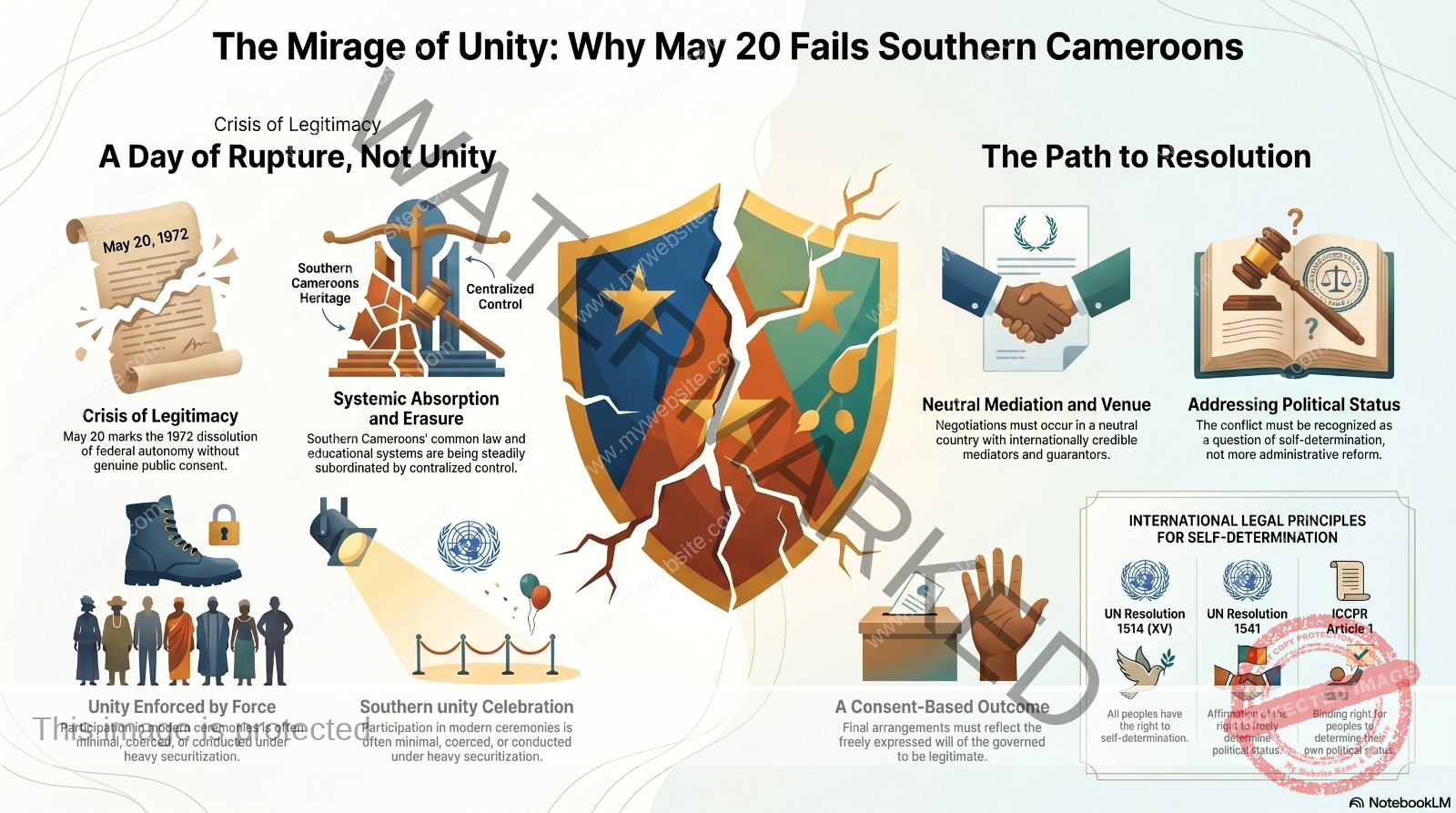
In 1972, under the leadership of Ahmadou Ahidjo, a referendum was organized to replace the federal structure agreed upon in 1961 with a centralized unitary state. This transformation fundamentally altered the constitutional relationship between Southern Cameroons and La République du Cameroun. But legitimacy is not created by procedure alone. It is created by consent.
The conditions under which that referendum took place—a one-party system, absence of open political competition, and lack of meaningful public debate—raise enduring questions about whether the people of Southern Cameroons ever freely consented to the dissolution of their federal autonomy. A union imposed cannot be celebrated as unity.
The Slow Erasure of a System
Southern Cameroons entered the union with a distinct legal and educational heritage rooted in the common law tradition. That system was not ornamental. It was foundational. Yet over the decades following May 20, that foundation has been steadily eroded: Legal systems gradually subordinated. Educational structures increasingly harmonized without parity. Administrative control centralized far from the people it governs. What is presented as national integration has often been experienced as systemic absorption. And absorption is not unity. It is replacement.
Celebration Under the Shadow of Force
Since 2016, the Anglophone crisis has transformed May 20 from a symbolic dispute into a lived contradiction. In many parts of Southern Cameroons: Participation is minimal or coerced
Public spaces are heavily securitized The absence of genuine civic enthusiasm is impossible to ignore. A national day that must be enforced by presence of force ceases to be a celebration. It becomes a performance. And performances do not resolve political questions. They conceal them.
The Fundamental Contradiction
The defenders of May 20 speak of territorial integrity. Those who reject it speak of self-determination. These are not rhetorical differences. They are structural contradictions. You cannot celebrate unity where a significant population contests the very foundation of that unity. You cannot invoke national identity where historical identity remains unresolved. And you cannot demand participation in a narrative that large segments of the population do not accept. To insist otherwise is not nation-building. It is narrative imposition.
International Law: The Question Cannot Be Avoided
This is not merely a political dispute. It is a legal one. Under United Nations General Assembly Resolution 1514 (XV) (1960), all peoples have the right to self-determination, and “subjection of peoples to alien domination… constitutes a denial of fundamental human rights.”
That principle was further reinforced by UN General Assembly Resolution 1541, as well as Article 1 of both the International Covenant on Civil and Political Rights and the International Covenant on Economic, Social and Cultural Rights, which affirm that all peoples have the right to freely determine their political status. These are not abstract declarations. They are binding principles of the modern international order.The unresolved question, therefore, is unavoidable.
Was the political status of Southern Cameroons ever conclusively settled in a manner consistent with these principles? If the answer remains contested, as it clearly is, then May 20 cannot be insulated from that legal reality. It becomes not a celebration of unity, but a marker of an unresolved decolonization process.
The Position of the Federal Republic of Southern Cameroons
Following the visit of Pope Leo XIV, a rare diplomatic opening has emerged, one defined not by coercion, but by moral clarity. The Government of the Federal Republic of Southern Cameroons has articulated a position grounded in both political logic and international law. The conflict must be resolved through a structured, internationally mediated process anchored in the principles of self-determination and consent.
This position rests on four core pillars.
First, a neutral mediation framework, with a mediator acceptable to both parties and supported by credible international guarantors.
Second, a neutral venue, with negotiations conducted outside La République du Cameroun to ensure procedural integrity.
Third, recognition of the conflict as a question of political status, not reduced to administrative reform or decentralization.
Fourth, a consent-based outcome, in which any final arrangement reflects the freely expressed will of the people. In this framework, the symbolism of the Papal visit underscores a deeper truth. Legitimacy cannot be manufactured. It must be recognized.
Rejection Is Not Extremism—It Is Coherence
To reject May 20 is not to reject peace. It is to reject contradiction. It is a refusal to legitimize a historical process that remains contested. It is an assertion that unity, if it is to exist, must be negotiated, not imposed. No people are obligated to celebrate the erosion of their own constitutional foundation.
The Way Forward
The future will not be shaped by parades. It will be shaped by truth. If unity is to have meaning, it must be rebuilt on historical reckoning, genuine dialogue, internationally credible mediation, and consent without coercion.
Until then, May 20 will remain what it has become in the eyes of many in Southern Cameroons. Not a day of unity, but a reminder of an unresolved question.
The Nuclear Finish
History is patient, but it is not passive. There is no precedent in modern international law where a people, having raised a credible claim grounded in self-determination, are indefinitely required to celebrate the very instrument of their political dispute. No doctrine compels a contested people to commemorate their own constitutional displacement. No legal principle transforms repetition into legitimacy.
May 20 does not resolve the question of Southern Cameroons. It exposes it. And the more it is performed without consent, the clearer that exposure becomes. For in the end, nations are not held together by ceremonies, but by legitimacy. And where legitimacy is unresolved, no parade, no matter how grand, can substitute for the simple, enduring requirement that defines all political order. The consent of the governed.
Ali Dan Ismael, Editor-in-Chief, The Independentist News
Share This Post:
THE AMBAZONIAN WAR OF INDEPENDENCE: How the enemy uses fear as a weapon and why Unity should be the defence.
An Anonymous Patriot and fervent reader of The Independentist News, writes to the editor saying Cameroon’s Unresolved Decolonisation Question goes beyond language
Related Post
IS THE WORLD LISTENING: THREE DAYS FOUR FRONTLINES, ASA
SEPTEMBER 24, 1965, THIS DAY IN HISTORY: From Equal
AMBAZONIA’S WAR- IS BIGGER THAN YAOUNDÉ: BRITAIN, FRANCE AND
THE DAY SEPTEMBER 22 1961: — WHAT AMBAZONIA CAN
TRUMP’S “SUPER INTELLIGENCE” ERA: WHAT IT REALLY MEANS —
Why Is Ambazonia More Powerful Than many Imagine.