

The world now faces a narrowing choice: continue to defend a structure whose legitimacy is eroding, or acknowledge that what is unfolding is not disorder — but delayed decolonization.
By Ali Dan Ismael
Editor-in-Chief, The Independentist News
In 1960, the world celebrated the end of empire. Seventeen African nations rose. Flags were raised. Anthems were sung. History, it was said, had corrected itself. It had not. It had merely concealed itself.
The Lie of Independence
What the world calls independence was not liberation. It was redesign. Under Charles de Gaulle, France did not withdraw from Africa. It restructured its control — replacing visible authority with invisible architecture. The 1958 referendum was presented as a choice. It was not. Accept the French Community and remain protected. Reject it — and face isolation. Only Guinea refused. France’s response was immediate and instructive: withdrawal, dismantling, punishment. The message was unmistakable: independence would be granted — but sovereignty would be conditional.
Françafrique: The Empire Without a Flag
What followed was not decolonization. It was systemization. Through currency control, military agreements, and political patronage, France embedded itself into the bloodstream of its former colonies. No flag was needed. No governor required. Control was exercised through structure. This system — Françafrique — did not end empire. It perfected it.
Britain’s Quiet Exit — And Its Lasting Consequence
While France redesigned control, United Kingdom executed a quieter withdrawal — but not a cleaner one. In the case of Southern Cameroons, Britain did not complete decolonization. It transferred responsibility. A people who had fought under the Commonwealth flag — whose fathers stood in defense of Europe during the Second World War, whose contributions helped sustain the very order that now governs international law — were not granted a complete path to self-determination. They were redirected into a political arrangement that would later bind them to a state structured under a different colonial architecture. This was not oversight. It was abdication.
Cameroun: The Instrument of a System
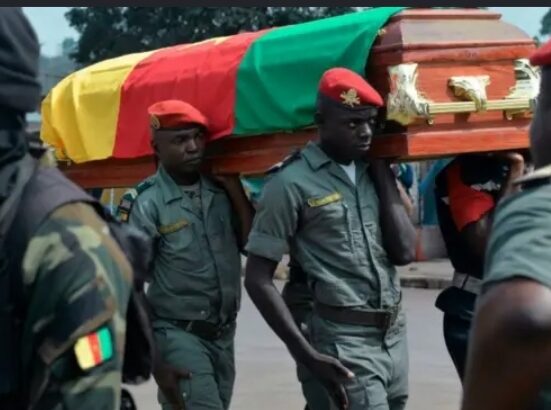
Today, what is called Cameroon is often treated as a sovereign actor. It is more accurately understood as a node within a larger system. Under Paul Biya, the state has functioned not simply as a government, but as an enforcer of continuity: continuity of centralized authority, continuity of external alignment, continuity of a post-colonial structure designed elsewhere. The violence witnessed is not deviation. It is enforcement.
Ambazonia: The Unfinished Question
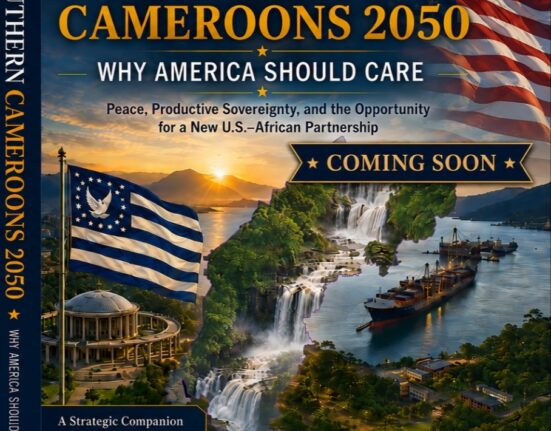
Ambazonia stands outside this design. It did not negotiate entry into Françafrique. It did not consent to absorption into a system it did not help create. Yet it was placed within it — and is now expected to remain within it. This is not unity. This is containment.
The Mislabeling of Reality
The world calls this an “Anglophone crisis.” This is not merely inaccurate. It is a deliberate dilution. There is nothing linguistic about state violence. Nothing administrative about systemic erasure. Nothing constitutional about the denial of a people’s political existence. Ambazonia is not a regional grievance. It is a structural contradiction.
The Disruption No One Planned For
For decades, this system endured because it was protected — not only by Paris and London, but by a global order that prioritized stability over truth. Then that order began to shift. The doctrine associated with Donald Trump did not set out to dismantle post-colonial systems. But it removed something they depended on: automatic protection. By challenging long-standing alliances, reducing unconditional commitments, and reframing international engagement through strategic value rather than historical obligation, a quiet but profound change occurred: the old imperial architecture was no longer guaranteed cover.
When Protection Fades, Reality Emerges
Systems built on external reinforcement do not dissolve quietly. They harden. They expose themselves. They reveal their mechanics. This is what is unfolding now. The violence is not incidental. The instability is not accidental. The contradictions are not surprising. They are the visible symptoms of a system losing its insulation.
A Moment the World Cannot Ignore
Ambazonia now exists at the intersection of two forces: a historical structure that never fully released control and a shifting global order that is no longer committed to protecting that structure. This is not merely a regional conflict. It is a test — of whether international norms apply universally, or selectively.
The Question That Now Confronts Power
If empire ended, why does its structure still govern outcomes? If sovereignty exists, why must it be enforced through inherited systems of control? If self-determination is a principle, why is it conditional in practice?
The Final Line the World Must Cross
Ambazonia is not asking for reinterpretation. It is forcing recognition — recognition that what was called independence was, in many cases, reassignment; recognition that what is called stability has often been managed imbalance; recognition that what is called unity can, in fact, be sustained coercion.
The Decision
The world now faces a narrowing choice: continue to defend a structure whose legitimacy is eroding, or acknowledge that what is unfolding is not disorder — but delayed decolonization.
Because the empire did not leave. It was maintained. And now — for the first time in generations — it is no longer certain it will be protected.
Ali Dan Ismael
Editor-in-Chief, The Independentist News