



Faith is not validated by proximity to power.
Authentic spirituality cannot be outsourced to institutions alone. The credibility of the church rests on truthfulness, not alignment. This is not a rejection of institutions—it is a re-grounding of them.
By Ali Dan Ismael, Editor-in-Chief, The Independentistnews
There was a time when the sanctuary stood apart—where the pulpit answered to conscience, not to cabinet; where faith spoke truth to power, not power speaking through faith. That line is now being tested.
Across Ambazonia, a troubling pattern is emerging—one that demands clarity, not slogans. It is the creeping tendency for state power, often operating through a civil-law, centralized mindset, to shape, steer, or be seen to influence religious institutions. When this happens, even subtly, it risks blurring a boundary that has long protected both the integrity of the church and the legitimacy of the state.
From Legal Order to Institutional Overreach
Civil law, in its pure form, is not the villain. It offers codification, predictability, and administrative order. But when fused with concentrated political power, it can slide from coordination into overreach.
The warning signs are familiar:
Administrative directives that spill into internal religious affairs. Expectations—formal or informal—that faith leaders align with prevailing political narratives. The use of regulatory levers to reward compliance or discourage dissent. When the state becomes an arbiter of religious tone, religion risks becoming an extension of governance rather than a moral counterweight to it.
The Ambazonian Tension
Ambazonia’s legal culture—shaped by Common Law instincts—has historically favored pluralism, association, and a measure of distance between state and sanctuary. That distance is not hostility; it is protection. It ensures: The church can comfort without coercion. The state can govern without claiming moral monopoly.
Recent debates and public reactions involving figures such as Andrew Nkea Fuanya and Samuel Fonki Forba highlight how sensitive—and consequential—this boundary has become. Whether one agrees or disagrees with particular statements or decisions, the larger issue is unmistakable: When religious voices are perceived as aligned with state priorities, trust fractures. And when trust fractures, both institutions suffer—the church loses moral independence; the state loses credibility among believers.
The Papal Moment—and the Battle for Narrative
The visit of Pope Leo XIV was more than ceremonial. It was a rare moment when global moral authority intersected directly with a local crisis. The Pope spoke—calmly, deliberately—about justice, exploitation, and the cycles of violence that have scarred the land. His words carried weight not because they were loud, but because they were clear. But clarity is dangerous to systems built on control. As the message unfolded, two parallel reactions appeared to take shape.
First, there were reports and widespread perceptions that electricity was cut in key areas, limiting access to the Pope’s remarks. To many, this did not feel accidental. It felt calculated: If you cannot silence the speaker, you reduce the audience.
Second—and perhaps more revealing—were accounts that individuals had been prepared in advance to present narratives designed to discredit the Ambazonian cause. Carefully framed testimonies, emotionally charged but strategically aligned, were expected to shape the Pope’s perception.
Yet something unexpected happened. The Pope did not amplify these narratives. He did not echo them.
He did not allow them to redefine the moral center of his message. Instead, he remained anchored—focused on principles, not performances.
Whether by discernment, experience, or quiet intelligence, the attempt to choreograph perception appeared to fall flat. The staged gave way to the substance of reality. And in that moment, a deeper truth emerged: Authentic moral authority cannot be scripted.
Under the long-standing rule of Paul Biya, critics have long argued that narrative management is a central tool of governance. But when narrative management extends into the spiritual arena—when even a papal encounter becomes a stage—then the line between governance and manipulation of conscience becomes dangerously thin.
The Economy of Influence Within the Church
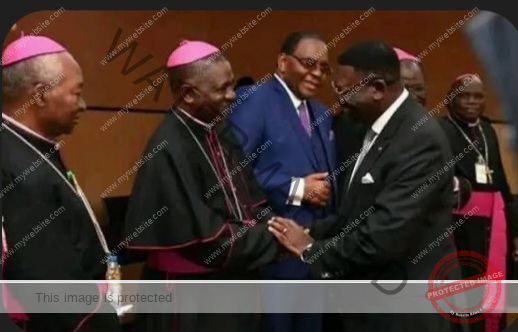
Beyond narrative control lies a more subtle—and more corrosive—dynamic: the quiet economy of influence. There are growing perceptions across the population that segments of the clergy—priests, bishops, and archbishops—are courted with material incentives, financial support, and state-linked privileges. The expectation, critics argue, is not always spoken, but often understood:
Alignment brings access. Silence brings security. Dissent brings isolation. When such perceptions take root, even without formal proof, the damage is immediate:
Sermons are scrutinized not for truth, but for who they serve. Pastoral letters are read as policy signals rather than moral guidance. The sacred trust between shepherd and flock begins to erode.
This is not an indictment of all clergy—far from it. Many continue to serve with integrity, courage, and sacrifice under immense pressure. But the perception of inducement—whether through gifts, funding, or preferential treatment—creates a shadow that falls over the institution as a whole.
And in that shadow, a dangerous transformation occurs: The church risks being seen not as a conscience—but as a conduit.
Politicization Is a Two-Way Risk
It is tempting to reduce the problem to a single direction—state imposing on church. But the risk is bidirectional: The state may seek to influence or instrumentalize religious authority. Religious leaders, in turn, may be drawn into political positioning, willingly or under pressure.
Either path leads to the same destination: the politicization of the sacred. That is where caution is essential. Not condemnation—caution. Not caricature—clarity.
Why the Boundary Matters
History offers a consistent lesson: societies remain stable when moral authority and political authority are distinct yet dialogic. The church must retain the freedom to challenge injustice, even when inconvenient. The state must retain the authority to administer law, without claiming spiritual jurisdiction.
Collapse that distinction, and you create: Compliance where there should be conscience. Silence where there should be witness. In such an environment, citizens begin to wonder whether sermons are spiritual guidance or policy echoes.
A Necessary Re-centering
Amid this tension, there is a growing call for spiritual clarity beyond institutional alignment—a return to the core of faith as relationship, conscience, and integrity. Voices like Judith Elondo, through messages such as Connect With God, emphasize something the moment urgently needs:
Faith is not validated by proximity to power.
Authentic spirituality cannot be outsourced to institutions alone. The credibility of the church rests on truthfulness, not alignment. This is not a rejection of institutions—it is a re-grounding of them.
The Way Forward
This is not a call for confrontation. It is a call for discipline of boundaries: For the State: Govern firmly, but refrain from shaping the internal voice of religious bodies. Administrative reach must not become moral control. For the Church: Speak pastorally and prophetically, but guard independence. Proximity to power should never replace accountability to conscience. For the Public: Engage critically but fairly. Distinguish between disagreement and delegitimization; between scrutiny and suspicion.
The Final Word
The question is not whether law and religion will interact—they always do. The question is how. If civil-law impulses are allowed to drift into control, religion becomes policy. If religious authority drifts into partisanship, faith becomes politics. Neither serves the people.
Ambazonia’s strength has long been its capacity for free association and moral expression. Preserving that strength now requires something even greater than conviction: The courage to resist not only the silencing of truth—but the quiet purchase of it.
Ali Dan Ismael, Editor-in-Chief, The Independentistnews